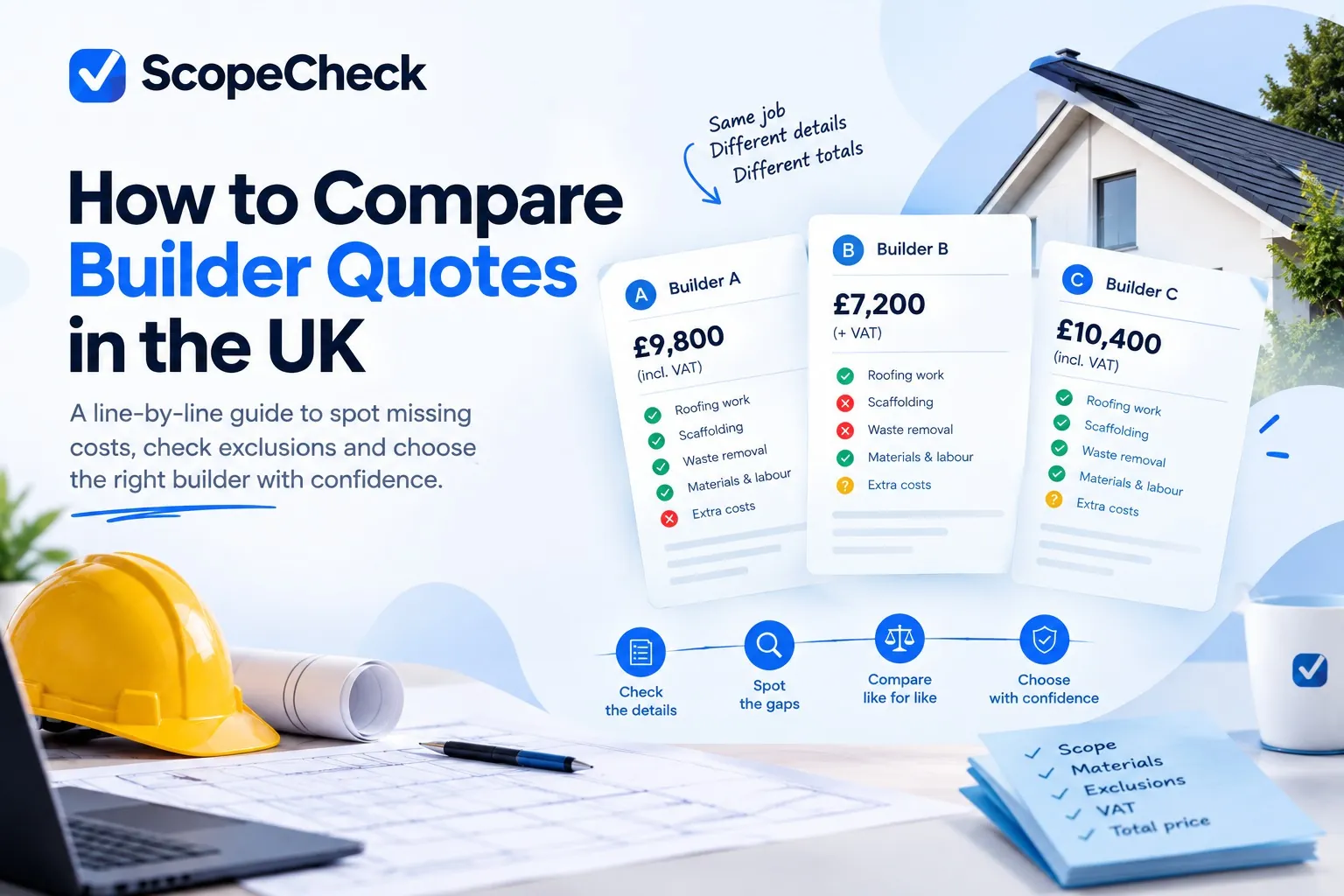
Three builders send three quotes for the same job. One is £2,000 cheaper than the others, and it looks like an easy decision. Then you notice the cheap quote is half a page long and never mentions waste removal.
This is the most common problem homeowners face when comparing builder quotes in the UK. The totals look comparable, but the quotes are often pricing different jobs. This guide shows you how to compare them properly, line by line, before you pay a deposit.
Why builder quotes rarely match
Builders don't usually price from a shared specification. Each one decides what to include, which materials to allow for and what to leave for you to sort out. That is why two quotes for the same project can differ by thousands of pounds without either builder doing anything wrong.
The usual reasons quotes don't match:
- Different scope. One quote includes scaffolding, plastering or decorating. Another says nothing about them.
- Different materials. A quote may allow for a basic product while another assumes a premium one.
- Provisional sums and allowances. Some costs are placeholders that can change once work starts.
- Different VAT treatment. One total includes VAT and another adds it later.
- Different levels of detail. A one-line price hides what you are actually buying.
The cheapest quote is often the one that describes the least work. Your job is to find out whether that is true before you choose.
Before you compare: give every builder the same brief
The easiest way to get comparable quotes is to ask for them on the same basis. Before you contact anyone, write a short list of exactly what you want done. Then:
- Send the same list, plans and photos to every builder.
- Ask for an itemised quote, not a single lump sum.
- Ask how VAT is shown, and whether the price is fixed.
- Ask for the start date, duration and how long the quote stays valid.
Three quotes is a common starting point, and two is the minimum for a meaningful comparison. More quotes only help if they are based on the same brief.
How to compare builder quotes line by line
Use this seven-step method. You can do it in a spreadsheet or on paper.
The 7-step method at a glance
- 1Build one master listYour list of the work, not a builder’s
- 2Mark every lineIncluded, excluded, unclear or not mentioned
- 3Look for the usual gapsScaffolding, waste, making good, fees
- 4Check materials and allowancesBrands, specs and provisional sums
- 5Put VAT on the same basisAll before VAT, or all after
- 6Put a price on the gapsGet an adjusted total for each quote
- 7Compare terms and timingDeposit, start date, guarantees
Step 1: Build one master list of the work
Start with your own list of jobs, not any builder's. Write every item you expect to be done, for example "remove old roof covering", "scaffolding", "new tiles", "clear and dispose of waste". This list is the yardstick. Every quote is checked against it, rather than against another quote. That stops the shortest quote from looking cheapest simply because it describes less.
Step 2: Mark each line included, excluded, unclear or not mentioned
Go through each quote and mark every item on your master list. Use four labels:
| Label | What it means | What to do |
|---|---|---|
| Included | The quote clearly covers it | Note the wording for your records |
| Excluded | The quote says it is not covered | Add an estimated cost to the total (step 6) |
| Unclear | The wording is vague or partial | Ask the builder to clarify in writing |
| Not mentioned | The quote says nothing about it | Ask. Silence is not the same as included |
The last row matters most. A missing line is not the same as a covered line, and "not mentioned" is where surprise costs tend to appear.
Step 3: Look for the usual gaps
Certain items are left off quotes more often than others. Check each quote for these:
| Often missing | Why it matters |
|---|---|
| Scaffolding and access | Needed for roofing, some extensions and high-level work, and can be a large cost |
| Skip hire and waste removal | Old materials have to go somewhere, and someone has to pay |
| Making good | Plastering, painting and flooring repairs after the main work |
| Protection and clean-up | Floor covering, dust control and final clean |
| Fees and permits | Building control, parking permits or other charges |
| Connections | Electrical, plumbing or heating tie-ins to existing systems |
| Materials and fittings | Who buys them, and to what specification |
Step 4: Check materials and allowances
Two quotes can use the same words and mean different products. Look for named brands, specifications and quantities. Be careful with provisional sums (a placeholder amount for work that cannot be priced yet) and prime cost sums (an allowance for materials or products you choose later). If the real cost ends up higher, the difference usually falls to you. Ask what each allowance covers and what happens if it is exceeded.
Step 5: Put VAT on the same basis
Some quotes show prices including VAT and some add it at the end. Others come from builders who are not VAT-registered and don't charge it at all. Compare every quote either all before VAT or all after VAT. The difference can flip the ranking:
| Quote 1 | Quote 2 | |
|---|---|---|
| Price as quoted | £7,000 + VAT | £8,200 including VAT |
| Price including 20% VAT | £8,400 | £8,200 |
| Which is cheaper? | Quote 2, by £200 |
The VAT rate can vary depending on the type of work and your circumstances, so check with HMRC or ask each builder to state how they have calculated it.
Step 6: Put a price on the gaps
For every excluded or unclear item, work out what it would cost. The best source is the builders themselves. Ask each one to price the missing item, then add it to their total. If that is not possible, use a reasonable estimate from a current UK price guide (our job guides list typical UK prices from published cost guides) and label it clearly as an estimate. The aim is an adjusted total for each quote, covering the same work.
Step 7: Compare payment terms and timing
Once the scope matches, compare the practical details:
- Deposit and payment schedule. What is the deposit for, and are later payments tied to stages of the work? Our guide to how much deposit a builder should ask for explains what to check.
- Start date and duration. A cheaper quote that starts in four months may not be cheaper for you.
- Quote validity. How long is the price held?
- Insurance and guarantees. What cover and warranty come with the work?
- Changes. How will variations be priced and agreed in writing?
Worked example: comparing three roofing quotes
Here is how the method works in practice. These figures are illustrative only. They are not real quotes or price guidance.
First, the scope check against the homeowner's list:
| Work item | Quote A | Quote B | Quote C |
|---|---|---|---|
| Remove old roof covering | Included | Included | Included |
| Scaffolding and access | Included | Included | Excluded |
| Chimney leadwork | Included | Excluded | Included |
| Waste removal | Included | Not mentioned | Included |
| Timber repairs | Included | Included | Included |
Then the totals, before and after pricing the gaps (all before VAT):
| Quote A | Quote B | Quote C | |
|---|---|---|---|
| Price as quoted | £9,900 | £8,700 | £9,300 |
| Estimated cost of gaps | £0 | £1,300 | £900 |
| Adjusted total | £9,900 | £10,000 | £10,200 |
On paper, Quote B looks £1,200 cheaper than Quote A. Once chimney leadwork (estimated at £700) and waste removal (estimated at £600) are added, it is £100 more expensive. Quote C's missing scaffolding (estimated at £900) makes it the most expensive. Without the line-by-line check, the homeowner would have chosen the quote with the most hidden costs.
Quoted price vs adjusted total
IllustrativeQuote A: quoted £9,900, estimated missing work £0 to £0, adjusted total £9,900. Everything on the list included. Quote B: quoted £8,700, estimated missing work £1,300 to £1,300, adjusted total £10,000. Leadwork (£700) and waste removal (£600) added. Quote C: quoted £9,300, estimated missing work £900 to £900, adjusted total £10,200. Scaffolding (£900) added.
For more on roofing specifically, see what a roofing quote should include.
Questions to ask each builder
Once you have found the gaps, send the same questions to every builder and get the answers in writing. An email is enough. Keep it with the quote.
- Does the price include scaffolding or access, skip hire and waste removal?
- Which items are provisional sums, and what happens if the real cost is higher?
- Which materials and products have you allowed for?
- Is VAT included in this price? If not, how much will it add?
- What is the payment schedule, and what is the deposit for?
- When can you start, and how long will the work take?
- What is excluded that I would normally need to arrange myself?
- Is this a fixed price, and how long is it valid?
- How will changes to the work be priced and agreed?
- What insurance and guarantees come with the work?
Red flags to watch for while comparing
A quote doesn't have to be perfect, but these are worth questioning:
- A very short or vague quote with no breakdown of the work
- A price far below the others with no clear explanation
- Allowances or provisional sums with no stated amount
- Pressure to pay a large deposit or cash upfront
- Reluctance to put answers or changes in writing
One red flag does not make a builder untrustworthy, but several together are a reason to slow down and ask more questions.
Quote or estimate: know which one you have
A quote is generally a fixed price for a defined scope of work. An estimate is a best guess that can change. Ask each builder which one they are giving you, and what would cause the price to change. This is general information, not legal advice, so for contract questions speak to Citizens Advice or a solicitor.
Compare by hand or use a tool?
Everything above can be done in a spreadsheet. It takes time, particularly if the quotes arrive as PDFs, photos of paper copies or emails. If you would rather not build the table yourself, ScopeCheck can do the first pass. You upload 2–5 quotes as PDFs, photos or pasted text, and it shows what each quote includes, excludes or doesn't mention, with the builder's own wording behind each line. It adds VAT the same way to every quote, estimates the cost of missing work and suggests questions to send each trader. You can see it in action in our example report.
ScopeCheck is a decision aid. It doesn't inspect your home, check a builder's credentials or guarantee costs, so the quotes and the builder's written answers still matter most.
Frequently asked questions
How many builder quotes should I get?
Get at least two for a real comparison. Three is a common starting point. More quotes only help if every builder is pricing the same brief.
What should a builder's quote include?
A clear description of the work, materials and allowances, labour, access and waste removal, how VAT is treated, payment terms, start and finish dates, and how long the price is valid.
Is the cheapest builder quote the best?
Not necessarily. A lower total often means less work is included. Compare the scope line by line before you compare prices.
How do I compare quotes that use different materials?
Ask each builder to price the same specification, or note each allowance and compare the difference separately.
Final thoughts
The headline price is the least useful number on a builder's quote. What matters is what you are getting for it. If you list the work, mark every line, put VAT on the same basis and price the gaps, you can compare quotes fairly and ask the right questions before you commit. Do that before you pay a deposit, and you are much less likely to meet an unwelcome surprise halfway through the job.