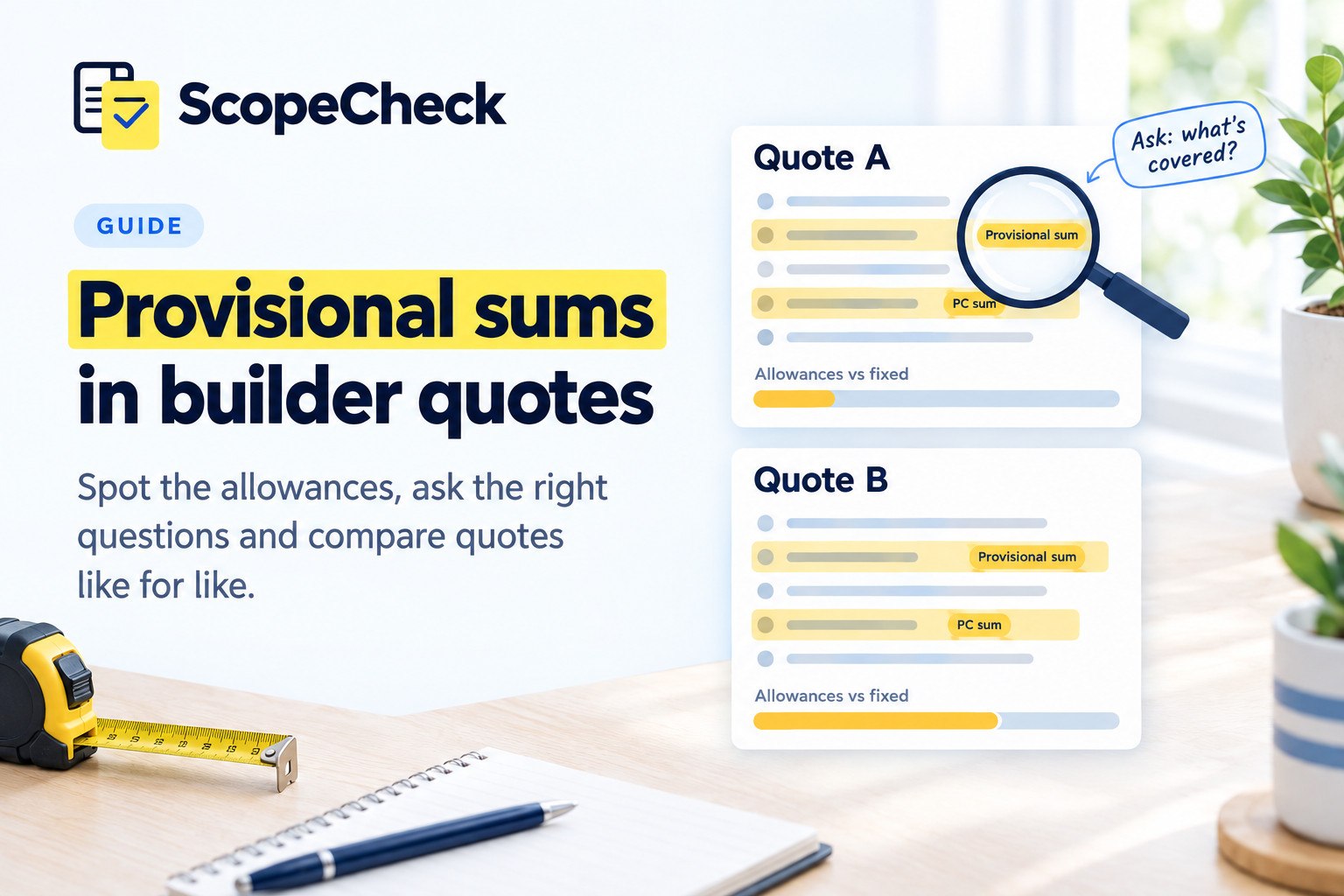
Provisional sums in builder quotes are allowances for work or costs that can't be priced exactly yet. They are not fixed prices, so a quote with several of them is less settled than its total suggests. This guide explains what they mean, how they differ from PC sums, and how to compare quotes when each builder has set different allowances.
It is a general guide, not legal or financial advice. For your rights in a particular situation, use Citizens Advice, gov.uk or a qualified professional.
Provisional sums in builder quotes at a glance
A provisional sum is a placeholder figure for something the builder can't yet price with confidence. Typical examples are drainage work before a survey, or foundations "as required" before the ground is opened up. The final cost can come out higher or lower than the figure shown.
Two quotes with different totals may not be comparable until you know how much of each is firm and how much is allowance. A lower headline price can simply mean more unknowns have been parked in provisional lines.
The method in this article has four steps:
1. List every provisional and PC sum in each quote. 2. Add them up and work out their share of each total. 3. Check whether each allowance is clearly defined or vague. 4. Ask each builder to price the same items firmly, or to use the same allowance, so the totals line up.
What a provisional sum actually means
A provisional sum is a sum of money set aside in the quote for work that isn't fully defined at the time of pricing. Put simply, it is the builder's best guess for something they can't price properly yet.
Common UK examples include:
- Drainage alterations where the existing runs haven't been surveyed or exposed.
- Structural steel before the engineer's final calculations and sizes are available.
- Foundations "as required" where depth depends on ground conditions found on site.
- Making good after opening up walls, floors or ceilings.
- Electrical or plumbing alterations where the extent of existing work is unknown.
Under many contracts, you pay the actual cost of the work, whether that is more or less than the allowance. If the work costs less, the difference should come off the final bill. If it costs more, the extra is normally added. The exact mechanism depends on what your contract says, which is why the wording matters.
This is also why a document containing provisional sums isn't fully a fixed price. Trading Standards guidance, such as that from Northumberland County Council, describes an estimate as a rough price that could change and a quote as an exact price that can't be increased later without your agreement. A quote with large provisional lines sits somewhere between the two. For more on that distinction, see the difference between a quote and an estimate.
Provisional sum vs PC (prime cost) sum
The two terms are often used loosely, and some builders mix them up. They do mean different things.
A provisional sum covers work that isn't yet defined. It usually includes labour, materials and sometimes plant or subcontractors.
A PC sum, or prime cost sum, is normally the supply cost of an item you haven't chosen yet, such as tiles, sanitaryware, taps or a kitchen. The builder allows a figure for buying the item, and fitting is priced separately or alongside.
| Provisional sum | PC (prime cost) sum | |
|---|---|---|
| What it covers | Work not yet defined | Supply of a specific item not yet chosen |
| Typical examples | Drainage alterations, foundations "as required", making good | Tiles, bathroom suite, kitchen units, appliances |
| Includes labour? | Usually yes | Usually no, fitting is priced separately |
| Who decides the final cost? | Depends on what is found and the work needed | You, through the choices you make |
| Adjusted at the end? | Yes, up or down to actual cost | Yes, up or down to the price of what you choose |
Overheads and profit on PC sums
Check whether the builder's overheads and profit are already inside a PC sum or will be added on top. Self-Build.co.uk advises agreeing at quote stage how the main contractor's overheads and profit are calculated on prime cost sums or variations, and says this typically adds an uplift of around 10% to 20% to the prime cost.
That uplift is not necessarily unreasonable, since the builder may be handling ordering, deliveries and coordination. The issue arises when one quote includes it and another doesn't say. Get the answer in writing before you compare.
Why one quote has more allowances than another
When two builders price the same job and one has far more provisional sums, there is usually a reason. Some are innocent and some are worth probing.
- Thin drawings or specification. If the plans don't show the detail, the builder can't price it firmly.
- No site visit. A quote prepared from photos or a phone call leaves more unknowns.
- Finishes not chosen. Without a decision on tiles, flooring or fittings, a PC sum is the only option.
- Risk moved to you. Some builders use allowances to avoid carrying the risk of a low figure, so the client absorbs any overrun.
A cheaper headline price can simply mean more unknowns have been pushed into allowances. Here is a hypothetical example, for illustration only:
- Quote A totals £92,000, but £14,000 of that is provisional or PC sums.
- Quote B totals £98,000, with only £4,000 in allowances.
On the face of it, A looks £6,000 cheaper. But if A's allowances end up £10,000 higher than shown, A finishes at £102,000, above B's price. If they come in as shown, A is cheaper. Neither outcome is certain. The point is that the totals alone don't tell you which quote is the safer or cheaper choice.
How to compare provisional sums in builder quotes, step by step
TrustMark advises getting 3 quotes before starting any work so you have a range of prices to compare. That only helps if the quotes are on a like-for-like basis. This is how to make them so. It builds on the general approach in how to compare builder quotes line by line.
Step 1: List every allowance in one table
Go through each quote and pull out every line described as provisional sum, PC sum, allowance, "budget", "as required" or "to be confirmed". Put them in a single spreadsheet or table with these columns:
- Item or description
- Whether it is a provisional sum or PC sum
- Amount
- Which quote it came from
- Whether labour, materials and fitting are included
Phrases like "allow for" and "budget figure" often mean the same thing as a provisional sum, even where the words aren't used.
Step 2: Add them up and work out the share
Total the allowances for each quote, then divide by that quote's overall price. A quote where allowances are a small share of the total is more settled than one where they are a large share. There is no official threshold that makes a share acceptable or not, so treat the percentage as a prompt for questions rather than a verdict.
Step 3: Check whether each allowance is defined
For each line, ask whether you could tell what work is covered. Compare these two:
- Vague: "Drainage, provisional sum £3,000."
- Defined: "Provisional sum £3,000 for diverting the existing foul drain at the rear, assuming one manhole and up to 6 metres of new pipe."
The second tells you what the figure is based on, and what would push it up or down. Bromsgrove District Council advises knowing what the builder has not included, and what arrangements exist for changes to the scope of works or problems found on site, including who pays for any extra work. A vague allowance leaves those questions open.
Step 4: Make the quotes like for like
Once you can see where the quotes differ, go back to each builder with the same request. Either:
- ask them to price the items firmly, perhaps after a survey, an engineer's input or a decision on finishes, or
- ask them all to use the same allowance figure for the shared items, so the totals can be compared directly.
If one builder won't firm up an item that could be priced with a little more information, that tells you something about how they handle risk. Keep the follow-up neutral and in writing.
A tool can speed this up. ScopeCheck's line-by-line comparison shows what is included, what is missing and where the prices really differ. You can compare your builder quotes side by side or see an example comparison report first.
Questions to ask your builder about each provisional sum
Copy and paste these into an email, adapting them to the item. Ask for answers in writing, and keep them with the quote.
- What exactly does this provisional sum cover, and what does it leave out?
- How was the figure set? Is it based on a survey, a supplier price or an estimate?
- What assumptions sit behind it (quantities, access, ground conditions, specification)?
- What would make it cost more? What would make it cost less?
- If it is underspent, will the difference be deducted from my final bill?
- Does the figure include your overheads and profit, or will they be added on top? If added, at what percentage?
- How and when will you tell me before the money is spent, and will I have to agree in writing?
- Can it be firmed up after a survey, once the engineer has finished or once the design is final?
- Does it include VAT?
- Who pays for any extra work if something unexpected is found on site?
Redbridge Council says every quote should include materials, labour, timeframes, responsibilities (including all subcontracting) and VAT. Flintshire Trading Standards advises making sure a quote breaks down the cost of doing the work and the cost of materials. Both are useful tests for any allowance line.
Protecting your budget before you sign
Provisional sums are normal in building work, and not a sign of a poor builder. The aim is to know where the uncertainty is and plan for it.
- Keep your own contingency separate. The builder's allowances are part of the quoted price. A contingency is your own reserve for surprises, so don't treat the two as the same pot.
- Check the contract wording. It should say how allowances are instructed, valued and adjusted, and how any difference is shown in the final account.
- Agree variations in writing first. If a provisional sum is going to be exceeded, you should hear before the work happens, not on the final invoice.
- Ask about payment terms. Allowances can affect how stage payments are calculated, so it is worth checking how they fit the payment schedule. Our article on how much deposit a builder should ask for covers this in more detail.
Kitchens and bathrooms are the most common places for PC sums, because fittings and finishes are often chosen after the quote. If you are weighing up kitchen quotes, it helps to compare kitchen quotes with the supply allowances for units, worktops and appliances set out clearly.
ScopeCheck compares quotation wording only. It does not inspect or certify work, or give legal or financial advice. If an allowance goes over budget and you disagree about who pays, Citizens Advice or a qualified professional can help with your specific position.
Frequently asked questions
What is a provisional sum in a builder's quote? It is an allowance for work or costs that can't be priced exactly at the time of quoting. Examples include drainage alterations or foundations "as required". The final cost can be higher or lower.
Is a provisional sum a fixed price? No. It is a best estimate, and you would normally pay the actual cost under the contract wording. A quote containing provisional sums is therefore not fully fixed.
What is the difference between a provisional sum and a PC sum? A provisional sum covers work that isn't yet defined, usually including labour and materials. A PC sum is generally the supply cost of an item you haven't chosen yet, such as tiles or a kitchen, with fitting priced separately.
Can a builder charge more than the provisional sum? Often yes, if the actual cost is higher and the contract allows adjustment. The contract should say how this is agreed, and you should expect to be told in writing before the extra cost is incurred.
How many provisional sums is too many in a builder's quote? There is no official limit. A better test is whether each one is clearly defined and whether, together, they make up a large share of the total. If so, ask the builder to firm up what they can.
Next step
Comparing quotes with different allowances takes patience, but it is far easier when everything sits in one view. ScopeCheck helps you compare 2 to 5 quotes line by line, so you can see what is included, what is missing and where prices really differ. There is a free preview for 2 quotes, and you can compare your builder quotes side by side when you are ready.
Compare the work, not just the price.