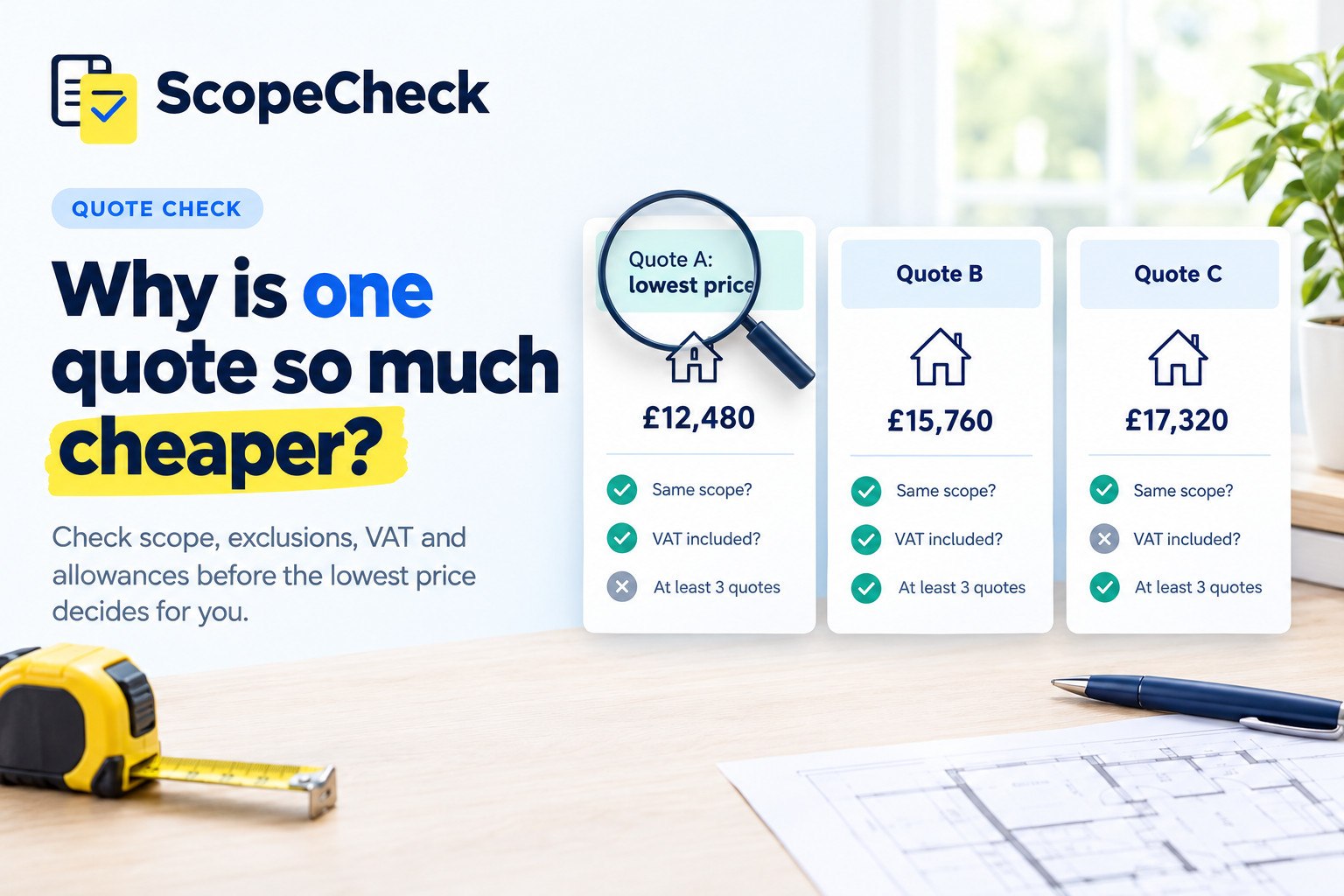
You have two or three quotes and one is far below the rest. A builder quote much cheaper than others is a prompt to check, not an automatic bargain or an automatic warning sign. The first job is to find out why the price is lower, and the answer is often something written (or missing) in the quote itself.
This article gives a practical checklist of the gaps that usually explain a low quote, plus questions to put to the builder. It is a general guide, not legal or financial advice. For disputes or your rights in a specific situation, use Citizens Advice or another official source.
The short answer
Bromley Council's building control guidance advises against automatically choosing the cheapest quote, especially if it is a lot cheaper than the others, and says to ask why. It also says to check the written quotations to make sure all the work is quoted for. That is the right approach.
In a 30-second summary, a much lower quote usually comes from one or more of these:
- Different scope: the quote covers fewer rooms, tasks or finishes than the others.
- Exclusions: items are listed as "by others", "by client" or not mentioned at all.
- VAT: one quote shows prices with VAT and another without.
- Allowances: low provisional sums or placeholder figures for items you have not chosen yet.
- Materials: a lower specification, or materials left for you to buy.
- Payment terms: a price that looks good but comes with a large payment before work starts.
Sometimes the lower price is simply a lower price. You only find out by comparing like with like.
Why one builder quote can be much cheaper than the others
There are genuine reasons for a gap. A smaller firm may have lower overheads. A builder may have a gap in the diary and price to fill it. Another may plan the work differently, using a method or sequence that saves time without changing the result. None of that is a problem, and a good price from a capable builder is a good outcome.
There are also less comfortable explanations:
- Missing work: something that is needed was left out, whether by accident or by design.
- A lower specification: cheaper fittings, thinner insulation, fewer coats of finish, or a simpler method than the others described.
- Limited experience: the builder has not priced for problems that someone who has done the job many times would expect.
- Underpricing to win the job: a figure set low to secure the work, with the expectation of adding extras later.
None of these means the builder is dishonest. A quote can be low because of an honest misreading of the brief. The point is that you cannot tell from the total alone, and it is the gap between the totals that needs explaining.
Citizens Advice recommends trying to get written quotes from at least three traders, and says comparing them helps you decide whether you are getting a fair price. That only works if the quotes describe the same job.
Check you are comparing the same job
Before you look at prices, look at what each quote actually says it will do. Put the quotes side by side and ask whether each one covers the same rooms, the same tasks and the same finishes. If you gave each builder a slightly different brief, or if one visited the site and another priced from a phone call, the totals cannot be compared fairly.
Redbridge Council says every quote should include materials, labour, timeframes, responsibilities (including all subcontracting) and VAT. Use that as a simple test. For each quote, check:
- Is the labour described, or only a lump sum?
- Are materials listed, and are they included in the price?
- Is there a start date, a duration or at least a rough timeframe?
- Does it say who is responsible for subcontracted trades such as electricians, plumbers or plasterers?
- Is VAT shown clearly, and is it included in the total?
Walsall Council's guidance adds that a written quote should break down the cost of the work and the materials, and say how long the quote is valid for. A single line reading "Extension, £X" gives you very little to compare.
If the quotes are based on different briefs, the cleanest fix is to give every builder the same written description and ask them to re-quote against it. For a fuller walk-through of the process, see our guide on how to compare builder quotes.
Seven gaps that make a quote look cheaper
These are the places where a builder quote far lower than the others most often hides its difference. Work through them for every quote, not just the cheap one.
1. Exclusions and "by others" items
Look for phrases such as "excludes", "by client", "by others" or "not included". Typical examples include electrical work, plastering, decorating, tiling, flooring or removing the old kitchen. What to look for: a list of exclusions in each quote, and a check that the same items are excluded or included across all of them.
2. VAT shown or not
A price without VAT can look noticeably lower than one that includes it. What to look for: an explicit statement on every quote of whether the total includes VAT. If it does not say, ask. If you are unsure whether VAT applies to your job, check gov.uk or ask an accountant.
3. Provisional sums and low allowances
A provisional sum is a placeholder for work or items that cannot be priced exactly yet. A low placeholder makes the headline figure look better but is likely to be adjusted later. What to look for: any line labelled "provisional", "allowance" or "PC sum", and whether the figure is realistic for what you want. Our article on provisional sums in builder quotes explains how these work.
4. Materials and specification level
Two quotes can both say "new bathroom" while pricing very different products. What to look for: named brands, product ranges or at least a clear specification (for example, the type of tile, boiler or window). Check who is buying the materials and who is responsible if they are late or wrong.
5. Waste removal, scaffolding and making good
These are easy to leave out. Skips, scaffolding, protection of floors, and making good after the work (plaster repairs, redecoration, patching brickwork) can add up. What to look for: a line for each, or a clear statement that they are excluded.
6. Fees and building control
Some jobs need building regulations approval, planning permission, structural calculations or an architect's drawings. What to look for: who is arranging and paying for these, and whether the cost sits in the quote or is left for you to handle separately. Check any fees against the same list in every quote.
7. Payment schedule and validity period
The payment terms can matter as much as the price. What to look for: when payments are due, what each stage is tied to, and how long the price is valid. A quote that expires quickly can push you to decide before you have finished checking. Also check whether it is a firm price or a best guess, which is the difference explained in the difference between a quote and an estimate.
Questions to ask when a builder quote is much cheaper than others
A direct conversation often settles things quickly. Here is a list you can copy into an email, so that the answers are in writing:
1. Please list everything that is excluded from this quote, including any items marked "by others" or "by client". 2. Are there any provisional sums or allowances? What is the figure for each, and what exactly does it cover? 3. Is VAT included in the total? If not, what is the VAT-inclusive figure? 4. Who is supplying which materials and fittings? Please name the products or specifications where you can. 5. Does the price include waste removal, skips, scaffolding and making good after the work? 6. Who is responsible for any building control, planning or design fees? 7. Is this a fixed quote or an estimate? Under what circumstances could the price change? 8. How long is the price valid for? 9. Which parts of the work will be done by subcontractors, and who is responsible for them? 10. What insurance do you hold, and can I see a copy of the certificate? 11. What is the payment schedule, and what is each payment linked to?
A reputable builder should be happy to walk through these. Clear, specific answers are a good sign. Vague or defensive replies are worth noting, but still compare them with what is in writing.
Get the answers in writing. If a builder says something on the phone that changes the scope or price, ask for a revised quote or a short email confirming it. This matters because, as Citizens Advice explains, a quote is a promise to do work at an agreed price, while an estimate is only the trader's best guess. With a quote, the trader generally cannot charge more unless there is a good reason, such as extra work you agreed to. A clear written record helps everyone understand what was agreed.
Beware the low price with a big deposit
A low price and a large upfront payment is a combination that deserves extra care. Bromley Council says stage payments as work progresses are normal, but homeowners should be wary of a builder who wants money before starting the work.
The reasoning is simple. If the quote is lower than the others and the builder also wants a significant sum before starting, more of the risk sits with you. If the work is delayed, changed or abandoned, you may have paid for something you have not received. A genuine reason for an upfront payment, such as made-to-order materials, should be explainable and ideally supported by a supplier order confirmation.
Questions worth asking:
- What exactly does the upfront payment pay for?
- Is it credited against the total price?
- Are later payments tied to finished, visible stages of the work?
- What happens to the payment if the start date slips or the job does not go ahead?
Our guide on how much deposit a builder should ask for goes through this in more detail. This is general information, not financial advice. If you are unsure about a payment arrangement, get independent advice before paying.
How to level your quotes line by line (and where ScopeCheck helps)
Levelling quotes means making them comparable, so that the differences left are real price differences. A simple method:
1. Pick the most detailed quote and list every item in it: each task, material, allowance and exclusion. 2. Tick each item off against the other quotes. Mark where it is included, excluded, described differently or not mentioned. 3. Add a rough note beside each gap, for example "no scaffolding mentioned" or "tiling excluded". 4. Send the gaps back to each builder, including the cheapest, and ask for the missing items to be priced or confirmed. 5. Compare the updated totals, with VAT treated the same way in each.
The gap may narrow once the missing items are priced. Sometimes it does not, and the lower quote turns out to be a good one. Either way, you are now choosing on facts rather than a headline number.
This can be done with a spreadsheet, but it takes time when quotes are formatted differently. ScopeCheck is built for this: it lets you compare your quotes line by line, showing what is included, what is missing and where prices really differ across 2 to 5 quotes. It compares the wording of the quotes only. It does not inspect or certify work, recommend or rank traders, or give legal or financial advice, and it does not take money from tradespeople. There is a free preview for 2 quotes, and a sample report on the site shows what the output looks like.
Frequently asked questions
Why is one builder's quote so much cheaper than the others?
Common reasons are a narrower scope, exclusions, VAT left out, low allowances or a lower specification. Occasionally it reflects lower overheads or spare capacity. Ask the builder to explain the gap in writing.
Is the cheapest builder quote always a bad sign?
No. A low quote can be perfectly sound if it covers the same work as the others. The risk is in assuming it does without checking, so compare scope, exclusions, VAT and payment terms first.
How do I check whether a low quote includes everything?
List every item in the most detailed quote and tick it off against the others, noting anything missing or described differently. Then ask each builder to price or confirm the gaps in writing.
Can a builder put the price up after I accept a quote?
According to Citizens Advice, with a quote the trader generally cannot charge more unless there is a good reason, such as extra work you agreed to. An estimate is a best guess and can change. For a specific dispute, contact Citizens Advice.
How many quotes should I get for building work?
Citizens Advice suggests trying to get written quotes from at least three traders. Give each the same written brief so the quotes can be compared fairly.
Next step: compare the work, not just the price
A big gap between quotes is a reason to look closer, not to panic or to celebrate. Check the scope, the exclusions, VAT, allowances and payment terms, put your questions in writing, and decide once the quotes describe the same job. If you would rather not build the comparison by hand, you can compare your quotes with ScopeCheck and see what is included, what is missing and where the prices really differ.