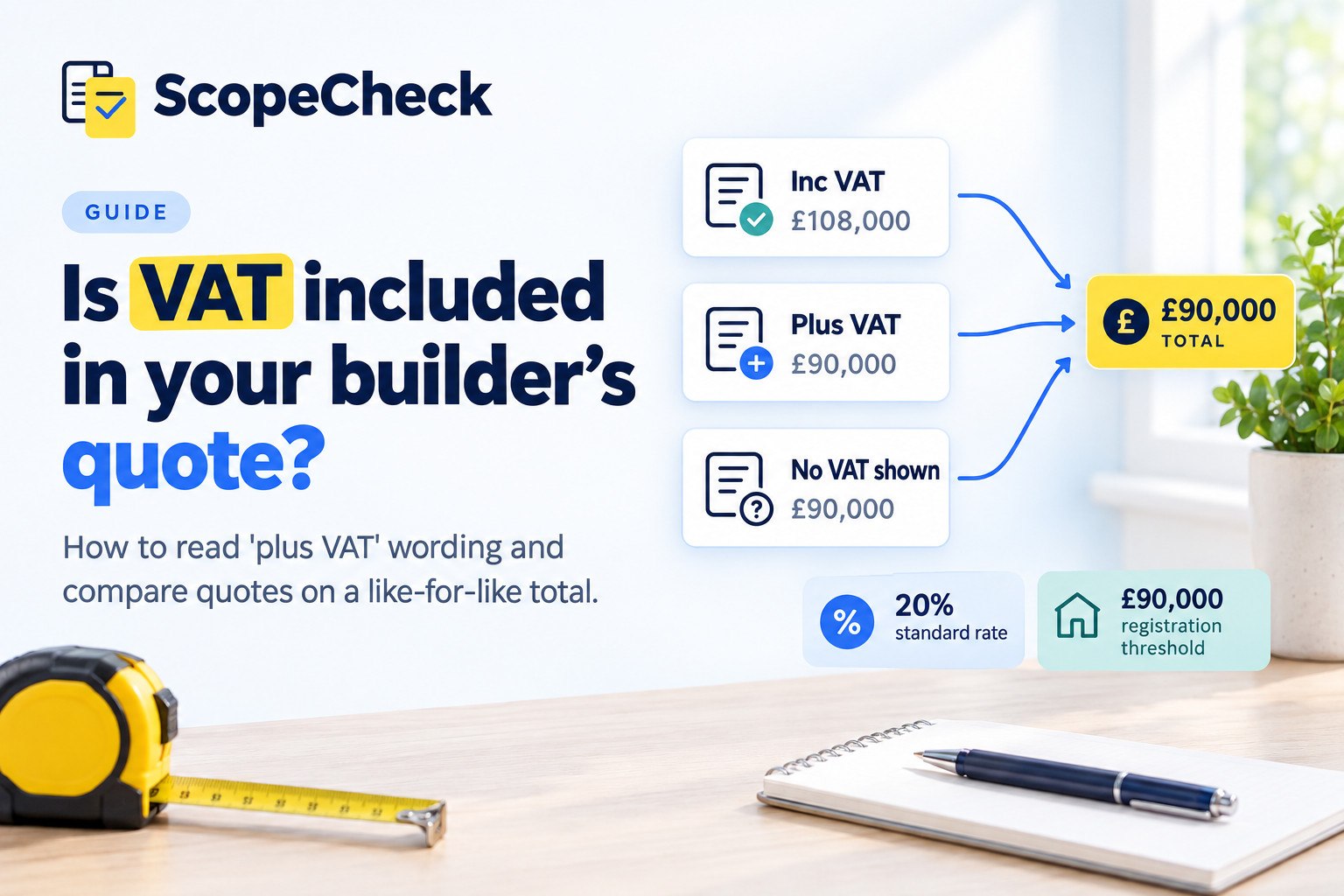
Whether VAT is included in a builder's quote depends on the builder and on how the quote is worded. Some quotes are VAT-inclusive, some say "plus VAT", and some do not mention VAT at all. Never assume which one you have, because the difference can be a substantial part of the price.
This guide explains how to read each wording, how to compare quotes fairly, and what to ask in writing. It is a general guide, not legal or financial advice. For your own situation, check gov.uk or HMRC.
The short answer: is VAT included in a builder's quote?
There is no automatic rule that a quote includes VAT. Most building work to an existing, occupied home is standard-rated at 20%, and a VAT-registered builder's quote should say whether the price includes VAT, is plus VAT, or shows net, VAT and gross. Builders below the VAT registration threshold do not charge VAT at all.
In practice:
- Always compare quotes on a VAT-inclusive total, the amount you would actually pay.
- Budget on that basis too. The FMB's renovation checklist says your budget should include the builder's quote plus VAT, where applicable.
- If the quote is unclear, ask for confirmation in writing before you decide.
How to tell if VAT is included in a builder's quote
Builders word VAT in several ways, and each affects the figure you should use. Scottish Borders Council advises homeowners to check whether the price includes VAT and to get detailed written quotations, so that you can compare like with like.
| What the quote says | What it usually signals | Figure to use for comparison |
|---|---|---|
| "Total £X inc VAT" | VAT is already in the price | £X |
| "Total £X + VAT" | VAT will be added on top | £X plus the VAT shown or confirmed |
| Net, VAT and gross lines | Fully itemised for a VAT-registered builder | The gross figure |
| A VAT number but no VAT wording | Likely registered, but the price basis is unclear | Ask before using any figure |
| No mention of VAT | Unclear: unregistered, or simply silent | Ask before using any figure |
"Inc VAT" and "+ VAT"
"Inc VAT" means the total already contains VAT, so there should be no further VAT charge on that scope of work. "+ VAT" means the headline figure is the net price and VAT will be added. A "builder quote plus VAT" can look cheaper than an inclusive one until you add the extra amount.
Net, VAT and gross lines
This is the clearest format. The net figure is the price before VAT, the VAT line shows the tax, and the gross figure is the total you pay. Use the gross figure.
A VAT number with no VAT wording, or no mention at all
A VAT number printed on the letterhead does not tell you whether the price includes VAT. Silence about VAT can be a source of surprise at invoice stage. Do not fill the gap with a guess in either direction. Ask the builder to state the basis in writing, and keep their reply with the quote.
This page cannot say what your legal position would be if a quote were silent and VAT appeared later. For that, Citizens Advice or a qualified adviser can help. The practical fix is to settle it before you sign.
Why one builder charges VAT and another doesn't
A builder must register for VAT once their taxable turnover passes the threshold, cited as £90,000 in a rolling 12 months. Confirm the current figure on gov.uk, as thresholds can change. Many smaller builders and sole traders are below that level and not registered, so they do not add VAT to their prices.
That can make an unregistered builder's quote look noticeably lower than a VAT-inclusive one. The saving may be smaller than it looks, because VAT status is only one factor in a price.
None of this makes one type of builder better than the other. Size, overheads and scope all affect price. If one quote is far below the rest, why one builder quote is much cheaper than the others covers the wider reasons beyond VAT.
When a "no VAT" deal comes from a registered trader
A builder offering a cash price without VAT needs some questions. As nidirect puts it, a VAT-free deal has one of two explanations: the builder is not registered for VAT, or they are avoiding VAT. The homeowner has to weigh whether the builder can finish the work and be around for any repairs afterwards.
If a builder who shows a VAT number offers to "knock off the VAT" for cash, ask plainly what would change on paperwork, invoicing and guarantees. Think carefully about what you would have in writing if something went wrong. A clear, itemised, written quote and a written contract protect you whichever way VAT is handled.
A worked example: comparing builder quotes with and without VAT
The figures below are invented and for illustration only. They show how three differently worded quotes for the same imagined job can be put on the same footing.
| Quote A | Quote B | Quote C | |
|---|---|---|---|
| Wording on quote | "£23,400 inc VAT" | "£20,000 + VAT" | "£19,500", builder not VAT registered |
| VAT-registered | Yes | Yes | No |
| VAT added at 20% | Already included | £4,000 | None charged |
| Gross figure to compare | £23,400 | £24,000 | £19,500 |
At first glance, Quote C looks the cheapest at £19,500, Quote B comes next at £20,000, and Quote A looks the most expensive at £23,400. Once VAT is treated consistently, Quote B is the most expensive at £24,000, Quote A sits in the middle, and Quote C is still the lowest.
Quote A's net price is £19,500, the same as Quote C's price, so on these invented numbers VAT accounts for the whole gap between those two. That will not always be the case. Where a remaining difference exists, it is not down to VAT, so look at scope. Ask what each quote includes, what it excludes and whether any provisional sums in builder quotes are hiding costs that could rise later. Also check whether each quote is a firm price or an estimate, as explained in the difference between a quote and an estimate.
The FMB advises comparing three itemised written quotes like-for-like and getting a written contract before work begins. Matching up VAT is the first step. Matching up scope is the second.
When the rate isn't 20%
Most work is charged at 20%, but some projects fall under different rates. This is only an overview, so check gov.uk and ask your builder which rate applies to your job and why.
- 5% reduced rate: it can apply to certain conversions to residential use and to renovating homes empty for at least two years.
- Energy-saving installs: installing qualifying energy-saving materials is zero-rated until 31 March 2027. From 1 April 2027 it is set to revert to the reduced rate of 5%, and no legislation currently extends the zero rate.
The 1 April 2027 change matters if your work could straddle that date. A quote priced before the change may assume one rate while the invoice falls after it. Ask the builder in writing which rate they have applied, and what would happen to the price if the timing moved. Confirm the details with gov.uk or HMRC rather than relying on a general guide.
The email to send each builder before you decide
Sending the same questions to every builder makes the answers easy to compare. You can copy and paste the following:
Putting the answers into your comparison
Once the replies arrive, build one simple table:
1. Write each builder's headline price. 2. Note whether VAT is included, to be added or not charged. 3. Work out the gross figure each builder would invoice. 4. Note any rate other than 20%, and the reason given. 5. Note anything the builder says is excluded or not covered by the price.
Keep the replies with the quotes. If a builder is vague about VAT, that is useful information in itself.
Compare VAT and scope side by side
VAT is only one line among many that make quotes hard to compare. Builders use different layouts, headings and levels of detail, and VAT wording sits alongside inclusions, exclusions and allowances. For a fuller process, see how to compare builder quotes line by line.
ScopeCheck lines up 2 to 5 quotes line by line, so VAT wording, inclusions and gaps are visible together. There is a free preview for 2 quotes, and an example report shows what the output looks like. ScopeCheck compares quotation wording only. It does not give legal or financial advice, inspect work or recommend traders, and it does not take money from tradespeople.
Frequently asked questions
Should a builder's quote include VAT?
A VAT-registered builder's quote should make clear whether the price includes VAT, is plus VAT, or shows net, VAT and gross figures. A builder who is not registered will not charge VAT. If the quote does not say, ask for the basis in writing.
What does "plus VAT" mean on a builder's quote?
It means the figure shown is before VAT and VAT will be added on top, usually at 20% for work on an existing home. Work out the gross total before you compare it with other quotes.
Can a builder add VAT after the work is finished if the quote didn't mention it?
This guide cannot give a legal answer, as it depends on the circumstances and the paperwork. The sensible approach is to settle the VAT basis in writing before work starts. If a dispute arises, Citizens Advice or gov.uk can explain your options.
Why is a builder who isn't VAT registered cheaper?
They do not add VAT to their prices, which can make the total look lower. Scope, overheads and the way the job is priced also affect the figure, so compare VAT-inclusive totals first and then compare what each quote covers.
Is VAT charged on both labour and materials in a builder's quote?
Many builder quotes bundle labour and materials into one price, and the VAT wording should make clear what that figure covers. Different rates can apply to different types of work, so ask the builder to confirm in writing what the VAT applies to, and check gov.uk or HMRC for your situation.
Next step: put your quotes side by side
Once you know the VAT basis of each quote, the remaining differences come down to scope. You can compare your builder quotes side by side to see what is included, what is missing and where the prices really differ, before you choose. Compare the work, not just the price.