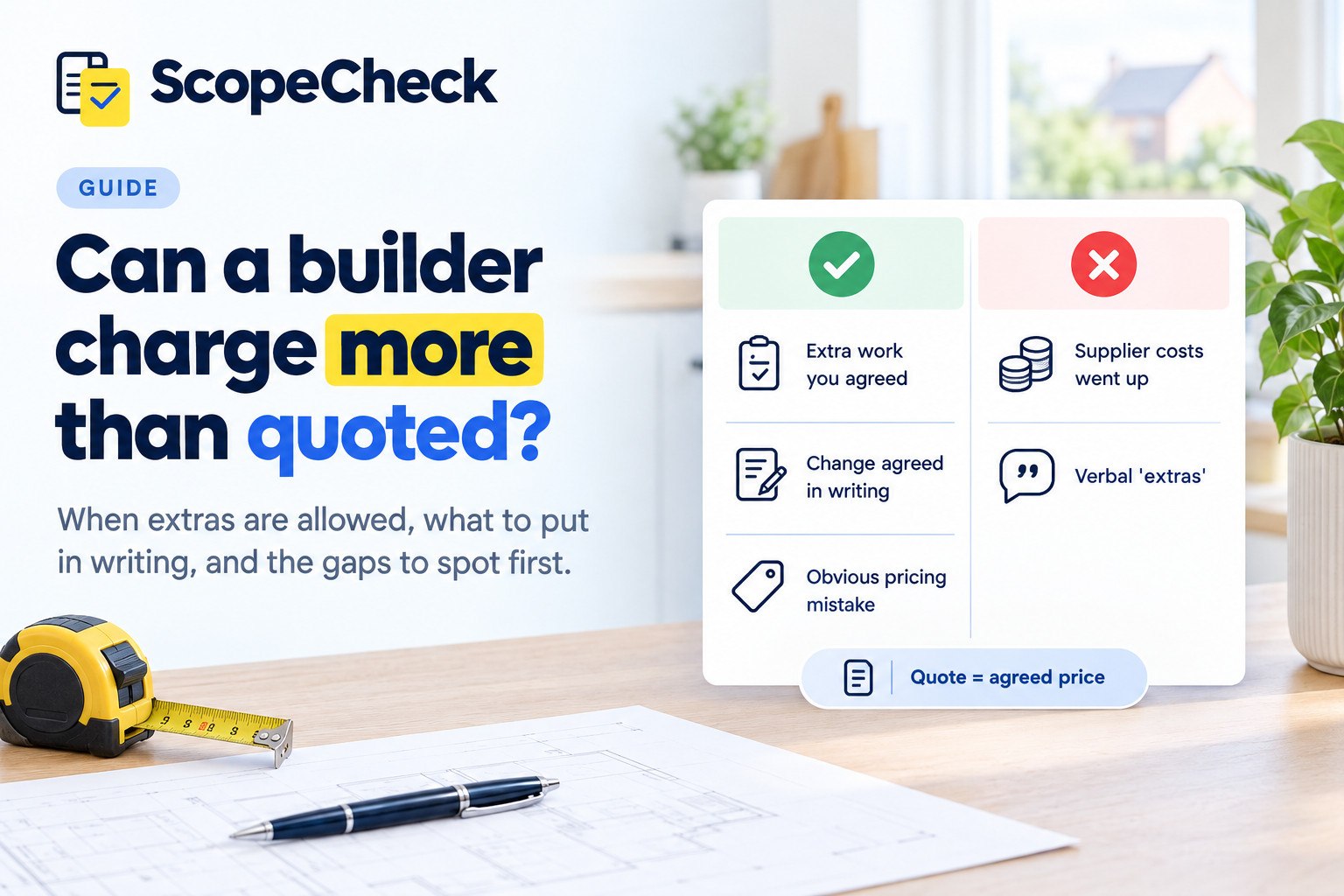
Can a builder charge more than the quote? Usually not, as long as you accepted a fixed price for a clearly described job. The main exceptions are work you later asked for, extra work the builder flagged and you agreed to pay for, and an obvious pricing mistake. Many disputes start where the quote was vague, not where the law is unclear.
This guide explains when extra charges are legitimate and when they are not. It also shows how to spot the gaps that later turn into "extras" before you sign. It is a general guide, not legal advice, so use Citizens Advice or a qualified professional for your own situation.
The short answer: can a builder charge more than the quote?
A builder generally can't charge more than an accepted fixed quote unless you asked for extra work, you agreed to pay for extra work they told you about, or the price contained an obvious mistake. Citizens Advice says a trader can't raise the price because their own costs have gone up since quoting. A builder saying materials cost more than quoted is therefore not, on its own, a good reason to ask for more.
An estimate behaves differently, because it is only a best guess at the cost. The final bill can legitimately differ from an estimate, although it should still be explained and reasonable.
First check what you were actually given: quote or estimate
Citizens Advice describes a quote (also called a quotation or fixed estimate) as a promise to do work at an agreed price. An estimate is the trader's best guess at the cost. The distinction matters because it changes what the builder can ask for later. If you want the full breakdown, see the difference between a quote and an estimate.
The label on the document matters less than the wording. Many documents headed "quote" behave like estimates, and the reverse is also true. Look for:
- A fixed total price, rather than "approximately", "from" or "around".
- A described scope, so you can see what the price covers.
- A validity period, showing how long the price holds.
- Wording that makes parts of the price flexible, such as "allowance", "provisional" or "subject to".
If the document is headed "quote" but half the lines are allowances, you effectively hold a fixed price for some work and an estimate for the rest. Ask the builder to confirm in writing which parts are fixed.
When a builder can legitimately charge more than the quote
According to Citizens Advice, there are broadly three situations where a higher price can be justified.
1. You asked for extra work. Moving a socket, upgrading a tile or adding a room to the scope all change the job. The price can reasonably change too. 2. The builder told you extra work was needed and you agreed to pay more. The key part is your agreement. A charge you were never told about is not covered by this. 3. The price was an obvious mistake. A misplaced decimal point or a clearly mis-added total might fall here. A builder simply having underpriced the job does not.
Provisional sums and PC sums
Some quotes include figures that are deliberately not fixed. A provisional sum is an allowance for work that can't be priced yet. A PC (prime cost) sum is an allowance for something you will choose later, such as tiles or a bathroom suite. Both are meant to be reconciled against the real cost, so the final bill can go up or down.
This is not a builder breaking the quote. It is the quote working as written. For more detail, read about provisional sums in builder quotes and what a PC sum is.
Genuine variation or unexplained add-on?
A variation is an agreed change to the work and price. A builder variation agreed in writing, before the work happens, protects both sides. These comparisons help you tell the difference:
| Genuine variation | Unexplained add-on | |
|---|---|---|
| Timing | Raised before the extra work is done | Appears on the final invoice |
| Cause | Your request, or a change you agreed to | "Forgot to include it" or "costs went up" |
| Price | Stated and agreed in advance | Lump sum with no breakdown |
| Link to the quote | Clearly outside the described scope | Falls within the scope you accepted |
| Record | Written and agreed by both of you | Verbal or none |
If an extra charge fits the right-hand column, ask for it to be itemised and checked against the original quote.
When a builder can't charge more than the quote: rising costs, slow progress and "forgotten" items
Rising supplier or labour costs
A builder who says "materials have gone up" is describing their own costs, and Citizens Advice says a trader can't charge more because their own costs have gone up since quoting. Builders can protect themselves by setting a short validity period on the quote or by clearly marking materials as allowances. They cannot add the risk back in after you have accepted a fixed price.
The same thinking applies if the job takes longer than the builder expected. A quote is a promise to do the work at an agreed price, so if the delay doesn't come from changes you requested, ask the builder to explain why slower progress should change what you pay.
"Forgotten" items that were part of the scope
A common dispute is an item that sounds obviously part of the job but is now billed separately. Examples include making good plaster after electrical work, removing waste, or fitting a supplied item. If the described scope plainly covers the task, you can reasonably ask why it is being charged again.
Silence versus "excludes" and "allowance"
There is a practical difference between a quote that is silent and one that spells things out:
- Silent: If a quote says "new bathroom installation" and doesn't mention tiling, you have a reasonable argument that normal finishing is included. It is still an argument, not a certainty.
- "Excludes": If the quote says "excludes tiling", the builder has told you it is not priced. You should expect to pay separately or arrange it yourself.
- "Allowance": If the quote says "tiling allowance", a figure is included but the final cost may differ, depending on what you choose.
The silent quote gives you the most room to argue, but the explicit ones give you the most clarity. Either way, resolve it before signing, not after.
Unforeseen conditions
Some surprises can't be priced in advance, such as rotten timbers behind a wall or an unmapped pipe. If the builder finds something unexpected, the sensible route is written notice, a clear description of the problem, a price for dealing with it and your agreement before the work goes ahead. Under Citizens Advice's reasoning, extra work only becomes chargeable if you were told and agreed to pay more. A discovery announced for the first time on the final invoice is not the same thing.
What if no price was agreed? The "reasonable price" rule
Sometimes a job starts on a handshake with no price settled. Under section 51 of the Consumer Rights Act 2015, if the price for a service isn't known from the outset, the consumer must pay a reasonable price, and what is reasonable is a question of fact.
In practice that means a figure the builder simply chooses is not automatically the price you owe. Your other quotes can serve as practical evidence of what similar work costs locally. Keep them, along with any messages that discuss price. This is a general explanation, not a legal conclusion, so check with Citizens Advice if the amount in dispute is significant.
What to do if your builder asks for more money
If you are wondering what to do when a builder bill is higher than the quote, work through these steps calmly and in order.
1. Don't agree verbally. A casual "fine, go ahead" on site can later be described as consent. Say you will review it and reply in writing. 2. Ask for the extra charge itemised against the original quote. You want to see which quote line each extra relates to, and what is new. 3. Check each item against the scope you accepted. Look for the wording on inclusions, exclusions, allowances and provisional sums. 4. Reply in writing and say what you will pay. Citizens Advice says that if a trader can't give a good reason, you can tell them you will only pay the quoted amount, and it is a good idea to put this in writing so you have a record. 5. Pay the undisputed part. Paying what you agreed shows good faith and keeps the disagreement narrow. Keep a note of what you paid and why. 6. Agree any genuine change in writing, with a price, before work continues. TrustMark advises using a written contract and agreeing any changes to the contract value in writing before the work is done. 7. Escalate if it isn't resolved. Contact Citizens Advice for guidance on your options, including whether a complaint to any trade body or scheme the builder belongs to is worthwhile.
Keep the tone factual. Builders who have simply miscommunicated may respond well to a calm written request for a breakdown. If a builder increased the price after the quote was accepted without any change in scope, that written record will matter most.
How to stop surprise extras before you sign
Many "extras" are visible in the quote beforehand. The trick is to read for what is missing, not just for the total. Citizens Advice advises getting quotes in writing rather than relying on a verbal one, and warns that a price a lot lower than other quotes could mean the trader isn't quoting for exactly the same work.
A quote-gap checklist
Before accepting, check each quote for:
- Exclusions: Is there a list of what is not included? If not, ask for one.
- Allowances and provisional sums: Which prices are placeholders, and how large are they compared with the total?
- "Subject to" wording: What conditions, such as survey findings or access, could change the price?
- Who supplies materials: Is it you or the builder, and to what specification?
- Waste removal: Is skip hire and disposal included?
- Making good: Does the price include plastering, decorating and repairs after the work?
- VAT: Is the total shown with or without it?
- The variation process: How will changes be priced, recorded and agreed?
Compare two to five quotes line by line
Totals hide a lot. One quote might look cheaper because it leaves out waste removal, making good or the supply of fittings, which are precisely the items that reappear as extras later. Putting two to five quotes side by side, line by line, shows what each includes, what is missing and where the real price differences sit. Our guide on how to compare builder quotes line by line walks through the method.
ScopeCheck does this comparison for you. It compares quotation wording only. It does not inspect or certify work, value property, or give legal or financial advice.
Frequently asked questions
Can a builder put the price up after I've accepted the quote?
Generally not, unless you asked for extra work, agreed to pay for extra work they told you about, or the price was an obvious mistake. Citizens Advice sets out these cases on its home improvements page. For your own circumstances, check with Citizens Advice.
Can a builder charge more because materials have gone up in price?
Citizens Advice says a trader can't charge more because their own costs have gone up since quoting. The exception is if the quote itself made that item an allowance or provisional sum, which is designed to move with the real cost.
Is a builder's estimate legally binding, and can the final bill be higher?
An estimate is the trader's best guess at the cost, so the final bill can differ from it. It should still be explained and reasonable, and it is worth asking for any increase to be itemised. If you want a fixed price, ask for a written quote.
What counts as a variation in a building contract, and does it have to be in writing?
A variation is an agreed change to the work and the price. This guide can't say whether a variation must be written to be valid, but TrustMark advises agreeing changes to the contract value in writing before the work is done, because it avoids disagreement later.
Do I have to pay a builder's invoice if it's higher than the quote?
Not automatically. Check each extra against the scope you accepted, reply in writing saying what you will pay, and pay any undisputed part. If you can't agree, Citizens Advice can explain the options for your situation.
Next step: check the quotes before you commit
The cheapest time to deal with an extra is before it exists. Reading exclusions, allowances and variation terms now is far easier than arguing about a bill later. If you are weighing up quotes, you can compare your quotes with ScopeCheck, with a free preview for two quotes. ScopeCheck is independent, does not take money from tradespeople and does not recommend or rank specific traders. Compare the work, not just the price.