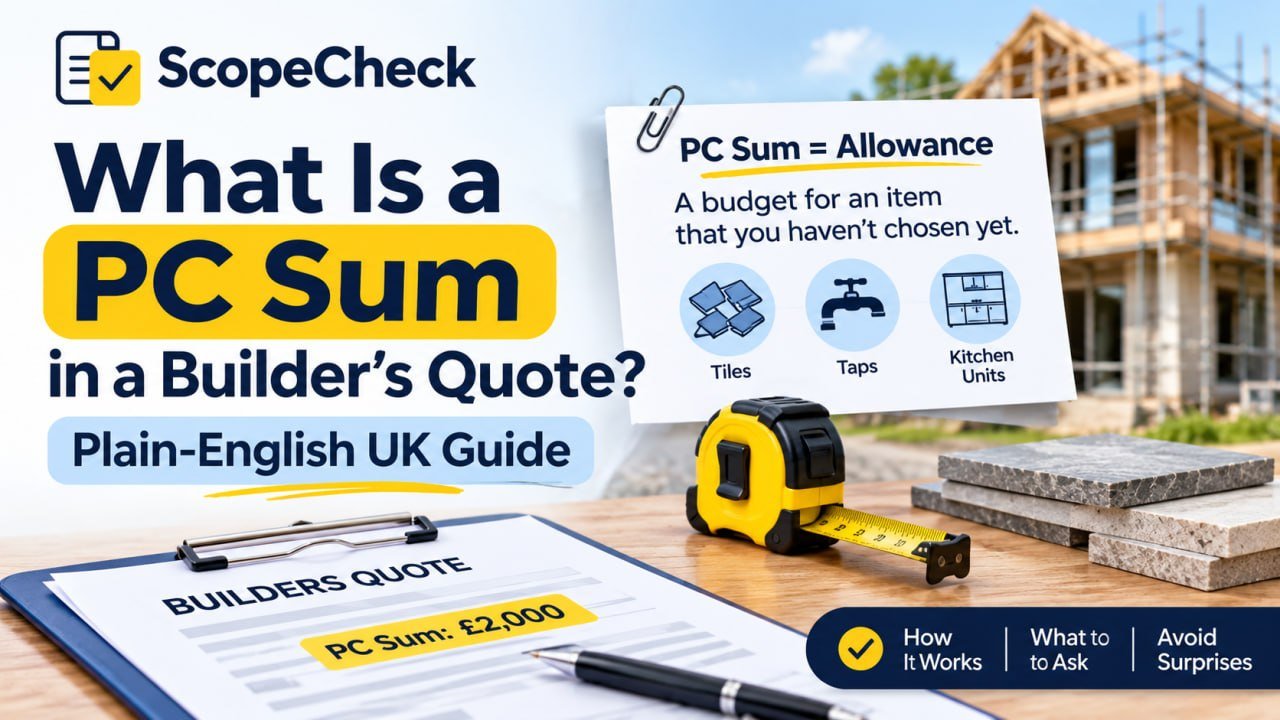
Your quote says “PC sum £2,000”. What does that mean for your final bill? The pc sum meaning is simple: it is an allowance for something you have not chosen yet, not a fixed price. This guide explains what is a PC sum, how a PC sum in a builder’s quote works, and what to ask before you sign.
What Is a PC Sum?
What Does PC Stand For?
PC stands for prime cost. The prime cost sum meaning in building work is the amount allowed for supplying materials or goods. Designing Buildings describes it as an allowance for items from a supplier, with the contract sum adjusted up or down once the real cost is known.
How Does a PC Sum Work?
In short, the pc sum meaning in practice is an allowance that is settled against the real price once you choose.
- The builder includes an allowance for the item in the quote.
- You choose the item, such as tiles or a bathroom suite.
- The builder compares the actual price with the allowance.
- You pay the difference if it is higher, or receive a credit if it is lower.
PC sum example: your quote has a PC sum of £1,500 for tiles. You choose tiles costing £2,100, so the difference is £600 extra, and possibly more if the contract adds builder’s margin or VAT. If you choose £1,200 tiles, you should expect a £300 credit. Check what your contract says, as terms vary. These figures are illustrative only.
PC Sum vs Provisional Sum: What Is the Difference?
| PC sum | Provisional sum | |
|---|---|---|
| Covers | Supply of a specific item | Work not yet fully defined |
| Example | Tiles, taps, kitchen units | Groundwork, hidden repairs |
| Price | Allowance, adjusted to actual cost | Estimate, replaced by actual work done |
| Ask | Is fitting included? | What triggers the final price? |
The pc sum meaning differs from a provisional sum. Designing Buildings explains the difference between the two. Contracts do not always define them the same way, so check the wording in your own quote. Our guide to provisional sums in builder quotes covers the other half.
Does a PC Sum Include Fitting and VAT?
Does a PC sum include fitting? In the formal construction definition, a PC sum is usually supply only, so fixing and installation are treated separately. But homeowner quotes vary, and “allowance” can mean different things. Ask your builder to confirm in writing whether the allowance covers:
- Installation or fitting
- Delivery
- Waste removal
- VAT
- Builder’s margin on the item
That also answers does a PC sum include VAT? It depends on the quote. Do not assume.
PC sum for kitchen, bathroom and tiles
These are the most common places to see an allowance: kitchen units and worktops, a bathroom suite, tiles, light fittings and flooring. Because choices vary so much, check kitchen quotes and bathroom quotes line by line.
What Happens If You Go Over (or Under) the PC Sum?
| Scenario | What usually happens |
|---|---|
| Over the PC sum | The contract price rises by the difference. Check whether margin or VAT is added. |
| Under the PC sum | The contract price should fall by the difference. Confirm how the credit is shown. |
Is a PC sum a fixed price? No. Can a builder add margin on a PC sum? Sometimes, but only if the contract says so. What happens if the PC sum is too low? You pay more once you choose, so ask for a realistic allowance up front.
How to Make a PC Sum Realistic Before You Sign
A PC sum is only as useful as the number behind it. A low allowance can make a quote look cheaper than it really is, then push the cost up once you choose. Before you accept a quote, try to firm up each allowance:
- Choose early. Visit a showroom or supplier and pick your tiles, taps or units before signing, if you can.
- Ask for the source. Ask the builder what price or supplier the allowance is based on.
- Get it itemised. An itemised quote shows which items carry an allowance and which are fixed.
- Set a decision date. Agree when you must choose, so delays do not hold up the job.
If you cannot choose yet, ask the builder to explain what quality level the PC sum assumes. “Mid-range tiles” means little without a figure or example.
PC Sum Terms Explained
Quotes use several related terms. Knowing them helps you read a PC sum in a builder’s quote with confidence.
- Allowance: a general word for money set aside for something undecided. A PC allowance is the same idea as a PC sum.
- Supply only: the item is bought and delivered, but not fitted.
- Supply and fit: the price covers the item and its installation.
- Nominated supplier: a supplier chosen by you or the client, rather than by the builder.
- Variation: a change to the agreed work or price, which should be agreed in writing.
- Contract price: the agreed total, which can change if allowances are adjusted.
- Exclusions: items the quote does not cover. Our guide to quote or estimate explains related wording.
Common PC Sum Mistakes Homeowners Make
- Treating a PC sum as the final price of the item.
- Assuming fitting, delivery and VAT are included without checking.
- Comparing builders by total price without comparing their allowances.
- Choosing items after the deadline and causing delays or extra costs.
- Agreeing price changes by phone instead of in writing.
The same care applies to deposits and payment stages. See how much deposit a builder should ask for, and for a trade-specific example read what a roofing quote should include.
Why PC Sums Make Quotes Hard to Compare
Imagine Builder A allows £500 for tiles and Builder B allows £2,500 (illustrative figures). Builder B looks dearer, but Builder A’s allowance may simply be unrealistic. Bring allowances to the same level before comparing totals. See our guide on how to compare builder quotes and why “included in the price” causes problems.
This is where ScopeCheck helps. ScopeCheck flags allowances and shows what each quote includes, so you can compare the work, not just the price. See an example report or try a free preview of two quotes.
Red Flags to Watch For
- A very low PC sum that makes the quote look cheap
- No breakdown of what the allowance covers
- “Allowance” listed with no item named
- No mention of margin on the item
8 Questions to Ask Your Builder About PC Sums
- What exact item does this PC sum cover?
- Is it supply only, or does it include fitting?
- Does it include delivery and waste removal?
- Is VAT included?
- Will you add margin to the actual price?
- Who chooses the item and by when?
- How will an over- or under-spend be shown?
- Will changes be agreed in writing before work proceeds?
FAQs
What is the pc sum meaning in construction?
A PC sum is an allowance for a specific item not yet chosen, such as tiles. The final price depends on the actual cost of what you select.
Is a PC sum the same as a provisional sum?
No. A PC sum usually covers supply of a named item. A provisional sum covers work not yet defined. Check each contract’s wording.
Does a PC sum include fitting?
Not necessarily. It is often supply only, but quotes vary. Ask your builder to confirm in writing.
What happens if I go over the PC sum?
Normally you pay the difference, and possibly margin or VAT if the contract allows. Check before you choose.
Can I get money back if I pick something cheaper?
You should expect a credit for the difference, but confirm the terms in your quote or contract.
Now you know the pc sum meaning: a placeholder, not a price. Understand it, question it, and get the answers in writing before you compare builders. Ready to compare? Compare your quotes on ScopeCheck.
ScopeCheck is provided by Dashient Ltd, a UK digital growth agency. This is general information, not legal advice. Check your own contract.