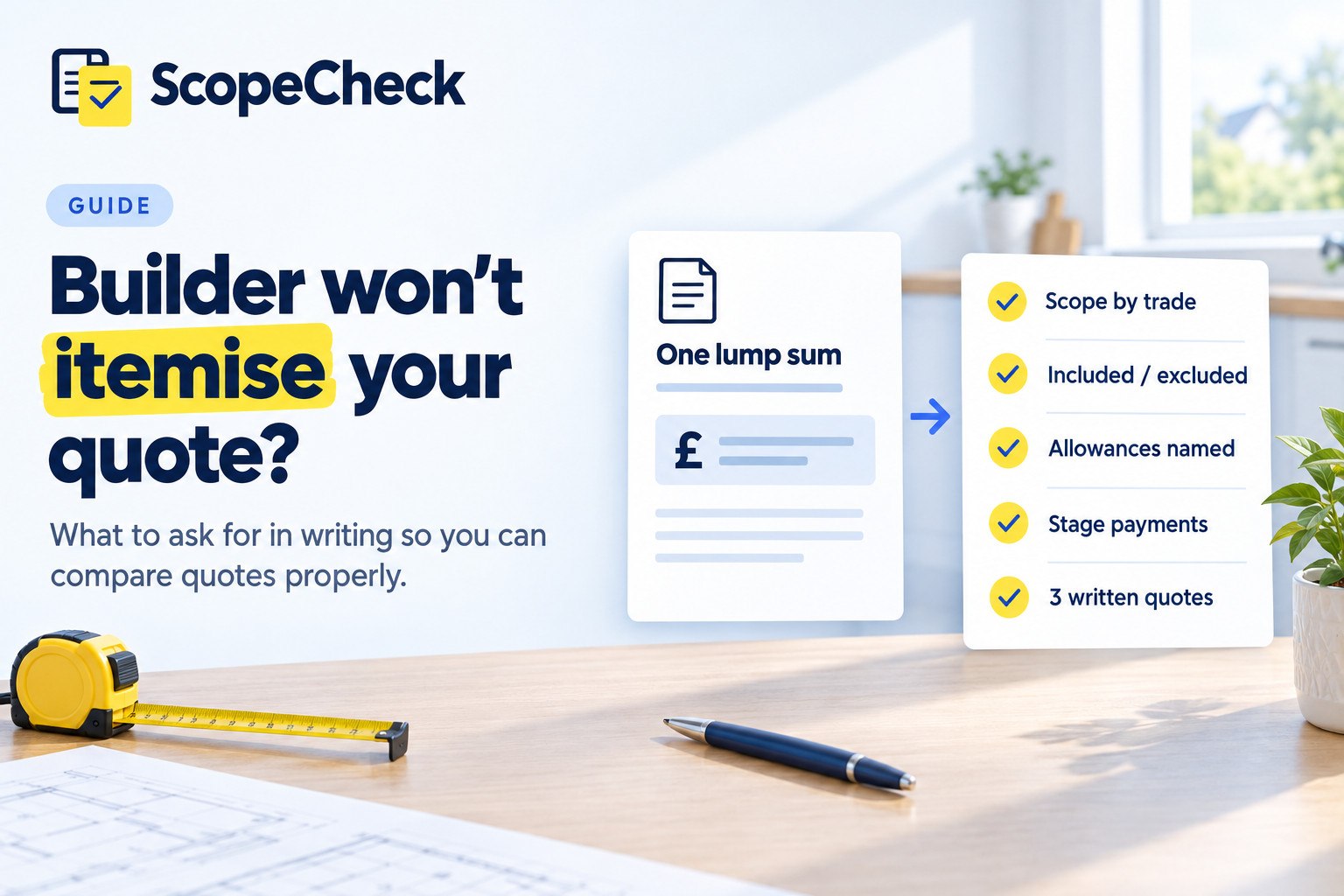
If your builder won't itemise the quote and has sent one figure, that is common and not automatically a red flag. What matters is whether you can see what the figure covers. A lump sum is workable when it comes with a written scope, clear exclusions and named allowances. It is not workable when it is just a number on a page.
This guide explains why builders do it, what detail you actually need, and how to ask for it. It also covers how to judge the reply. It is a general guide, not legal or financial advice.
The short answer
A builder does not have to put a price on every line. You should, though, be able to see three things before you compare or accept anything:
- Scope: what work is being done, by trade or stage.
- Inclusions and exclusions: what the price covers and, just as important, what it does not.
- Allowances: any sums set aside for items not yet chosen or priced, such as tiles or a kitchen.
A single figure with none of this is not comparable with other quotes. Ask for the missing detail in writing. If the builder will provide a stage-by-stage breakdown and a clear list of exclusions, the lack of line prices is usually fine. If they refuse to write anything down, treat that as a warning sign. The reasons are covered further down.
Why a builder won't itemise the quote and sends a single figure
Many builders who send a lump sum are not hiding anything. Builders commonly give reasons such as these:
- Itemising takes unpaid time, and a busy builder may quote several jobs a week.
- Experienced builders often price from similar past jobs rather than building the number up line by line.
- Some worry that an itemised quote will be used to cherry-pick, with the homeowner doing the profitable parts themselves or haggling over individual lines.
- Small jobs can feel too simple to justify a breakdown.
These are understandable. The problem is on your side of the table. With one number, you cannot tell whether two quotes cover the same work. You cannot check whether something you assumed was included really is. And if there is a disagreement later, there is nothing to point to.
The FMB also notes that detailed quotes can take a few weeks to produce, so a builder who asks for time is not necessarily stalling. A fair request for detail is reasonable, as long as it is proportionate.
Itemised, broken down or just detailed: what you actually need
People use "itemised" loosely. In practice there are three different things, and they do not carry equal weight.
| What it is | What it shows | How useful it is |
|---|---|---|
| Line-by-line pricing | A price for every task and material | Helpful, but time-consuming to produce and not essential |
| Breakdown by trade or stage | Cost split into groups such as strip-out, electrics, plastering, finishing | Very useful for comparing and for planning stage payments |
| Written scope with inclusions and exclusions | What is being done, to what standard, and what is left out | The most important of the three |
You can have the first without the third and still be misled. A quote with twenty priced lines can quietly leave out waste removal. A lump sum with a clear scope can be easier to compare than a long list of vague lines.
So the question behind "should a builder quote be itemised" is better framed as "does this quote show what I am paying for?" That is close to what Citizens Advice says a quote should include: a fixed total price (not a daily rate), how long the price is valid, whether VAT is included, when the price can go up, and exactly what you are paying for. The FMB similarly advises checking for a detailed breakdown of what is included and, importantly, what isn't.
The FMB's guide to choosing a builder goes further and suggests comparing itemised written quotes like-for-like. That is a good aim. Where a builder will not price every line, the scope and the stage breakdown get you most of the way there.
The minimum detail to ask for before you compare
If you are holding a builder quote with no breakdown, this is the shortest useful list to ask for. You do not need all of it for a small repair, but for a larger job most items should be present.
- Scope by trade or stage. For example: strip-out and making good, structural work, first fix electrics and plumbing, plastering, second fix, decorating, clearing up.
- Specification and quantities. How many spotlights, sockets, radiators or windows? What size and type? "New electrics" can mean very different things.
- Exclusions. What is not included, such as decorating, flooring, tiling, making good outside the work area, or building control and design fees.
- Supply-and-fit allowances. Where something is not yet chosen, the quote should say so. This is usually done through a PC sum or a provisional sum. Read up on what a PC sum is and on provisional sums in builder quotes, because they are one of the main places a price can move later.
- VAT status. Is VAT included, or added on top? Citizens Advice lists this as something a quote should state.
- Waste and skips. Who arranges and pays for waste removal, and whether that is in the price.
- Scaffolding and access. Whether it is needed and whether it is included.
- Stage payments. When money is due and what triggers each payment.
- Validity period. How long the price holds. Citizens Advice includes this in its list.
- Changes. How variations will be priced and agreed, ideally in writing.
If you are comparing several quotes, how to compare builder quotes shows how to line these items up.
How to ask a builder to itemise a quote: an email you can copy
Keep the request polite and narrow. You are not asking for every nut and bolt. You are asking for enough to compare quotes fairly. It also helps to say that every builder is getting the same request, because the FMB advises giving each builder the same details so quotes can be compared like-for-like.
You can adapt this:
If they ask for a few days
A short delay is normal, especially if the builder has to go back to a supplier or subcontractor. Agree a date in your reply, for example "that is fine, could you send it by Friday?" That is polite and gives you a clear point to judge from. If the date passes without a reply, or the breakdown keeps being promised but never arrives, that tells you something about how the job may be managed.
What a good reply and a bad reply look like
You will learn a lot from how the builder responds, sometimes more than from the numbers.
A good reply
- A stage-by-stage or trade-by-trade breakdown that adds up to the original figure.
- Clear exclusions, even if the list is short or slightly inconvenient.
- Named allowances, with an explanation of what each one covers.
- Willingness to put changes in writing. TrustMark advises insisting on a written contract and documenting any changes to it in writing.
- Questions back to you, such as "which tiles are you thinking of?" Builders who ask these have usually thought about the job.
A bad reply
- A refusal to put anything in writing beyond the total.
- "It's all included" with no list of what "all" means.
- Pressure to accept quickly, for example "the price won't hold".
- Vague catch-all lines such as "sundries" or "miscellaneous" with a large sum attached.
- A breakdown whose numbers do not add up to the original figure, or change noticeably from the first quote.
When a lump sum is fine
This is where "walk away" advice goes too far. A lump sum can be perfectly reasonable for a small, well-defined job, such as replacing a single window, fitting a like-for-like bathroom suite or repairing a short section of roof. The scope is obvious, there is little to separate and the risk of confusion is low.
It is much less suitable for larger or less defined work, such as an extension, a loft conversion or a full kitchen refit. There are more trades, more unknowns and more places for items to be left out. In those cases, the more complex the job, the more written detail you should expect.
This also answers the question of itemised vs fixed price builder quote. They are not opposites. A fixed price describes the total. Itemising describes how much detail sits behind it. You can have a fixed price with a good breakdown, or a fixed price with nothing behind it.
If your builder still won't itemise the quote: compare the wording you do have
Sometimes a builder simply will not break the price down. You still have options before you decide to drop the quote.
1. Ask for a signed written scope. It does not need prices, only a clear description of the work and exclusions. 2. Write your own scope list and ask the builder to confirm it. List what you expect: the rooms, the number of sockets, the finish, who removes waste. A reply of "yes, all included" in writing is far better than a verbal assurance. 3. Compare it line by line with the other quotes. Look at where the wording differs, not just the price. 4. Drop that quote. If the builder will not confirm anything in writing, the gap in information is itself the answer.
Be careful with a quote that looks cheaper. A quote with fewer words can look cheaper because it leaves things out. If one builder's price is lower and its description is shorter, ask whether the difference is efficiency or omission. For example, one quote may include skip hire, making good and a decorating allowance, while another says nothing on any of these.
This is the kind of check ScopeCheck is designed for. It compares the wording of 2 to 5 quotes line by line, showing what each one includes, what is missing and where the prices really differ. It compares quotation wording only. It does not inspect work, value your property or give legal advice. You can compare your quotes line by line and see a free preview for 2 quotes before deciding whether to go further.
Why the paperwork matters if the price changes
A detailed quote is not just about comparison. It is also what you fall back on if the price moves. The points below are a plain-English summary of Citizens Advice, so check the page itself for the detail that applies to you.
- A quote is a fixed price, so you know what you are getting and how much it will cost. An estimate is a rough guess, and you might pay more.
- A trader cannot charge more than the quoted price unless you ask for extra work that was not in the quote, or they made a genuine mistake writing down or calculating the price.
- Once you say yes to a quote it is a binding agreement, whether or not it is written down. Having it in writing lets you check and prove what you agreed if there is a dispute.
Put together, a vague scope makes it harder to say what was or was not "in the quote". If the quote simply says "kitchen refit" and nothing else, a later argument about whether the plumbing or wall repairs were included is hard to settle. For more on this, see what to do if a builder charges more than the quote.
This is general information, not legal advice. If you are in a dispute, Citizens Advice or a qualified legal professional can help with your specific situation.
Frequently asked questions
Is it normal for a builder not to itemise a quote?
Yes, particularly for smaller jobs. A single figure is common, but it should still come with a written scope and a list of exclusions so you know what is covered.
Is a builder legally required to give an itemised quote?
General guidance such as Citizens Advice's list of what a quote should include focuses on a fixed total, validity, VAT, when the price can rise and what you are paying for, rather than a price for every line. For your own situation, check with Citizens Advice or a legal professional.
How do I ask a builder for a breakdown without upsetting them?
Ask for a breakdown by stage or trade, not every item, and say you are asking every builder the same questions. Offer to talk it through on site and give a sensible deadline.
Is a lump sum builder quote the same as a fixed price quote?
Not necessarily. A lump sum is a single figure, and a fixed price means the total will not change unless you ask for extra work or there is a genuine mistake. A lump sum can be fixed, but you need the scope to know what it is fixed for.
Should I walk away from a builder who won't break down the price?
Not automatically. On a small, clearly defined job, a lump sum with a written scope can be fine. Be more cautious if the builder will not put anything in writing, pushes you to decide quickly or relies on vague wording on a larger job.
Next step: compare what you have
If you already hold two or more quotes and some are vague, start by sending the email above to each builder and noting how they reply. Then set the written answers side by side. ScopeCheck can compare your quotes line by line to show what is included, what is missing and where the prices really differ, so you can compare the work, not just the price.