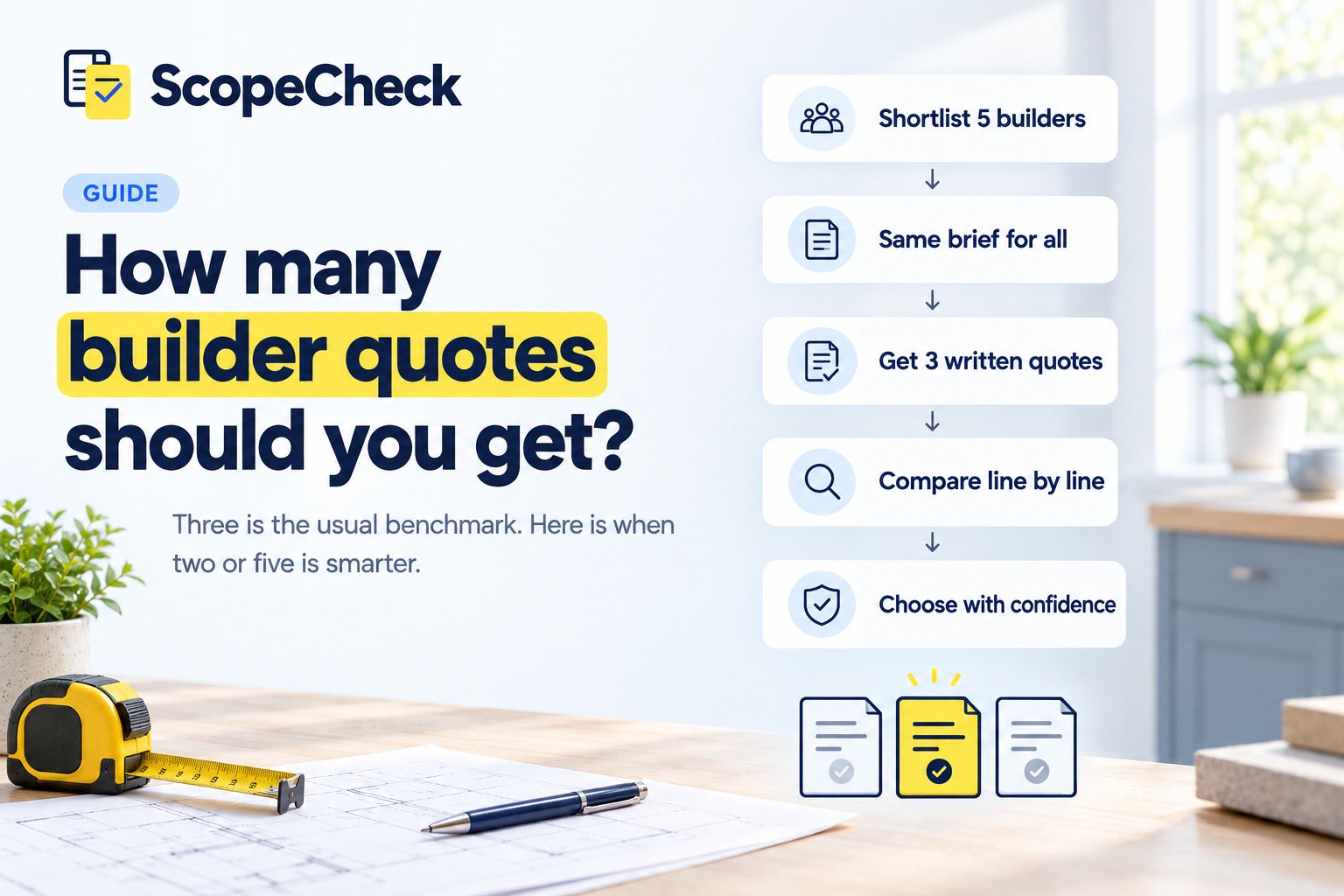
Most guidance says to get at least three written quotes, and that is a sensible default. So how many builder quotes should I get in practice? It depends on the size and complexity of the job: two can be enough for a small, simple repair, three suits most standard work, and up to five makes sense for an extension or other large project. The number matters less than whether the quotes can be compared like for like.
This is a general guide, not legal or financial advice. For your rights on a particular job, check Citizens Advice, gov.uk or TrustMark.
How many builder quotes should I get? The short answer
Aim for at least three detailed, written quotes. Citizens Advice says to try to get written quotes from at least three different traders before deciding. TrustMark and the Federation of Master Builders (FMB) give the same benchmark.
A practical rule of thumb by job size:
| Type of job | Quotes to aim for | Examples |
|---|---|---|
| Small, simple repair | 2 (3 if you have time) | Fixing a section of fencing, replacing a few roof tiles, a single-room repair |
| Standard job | 3 | Kitchen fit, bathroom refit, replacement windows, re-roof of a straightforward house |
| Larger or complex project | 3 to 5 | Extension, loft conversion, major structural work, unusual spec |
Treat the table as a guide rather than a rule. If the first quotes arrive far apart, or you are unsure what the job involves, asking one more builder is usually worth it.
Why three is the usual benchmark (and where it comes from)
Three is guidance rather than a rule. It is a widely repeated minimum that gives you enough information to judge a job without turning the process into months of admin.
According to the FMB, three quotes give you a better idea of likely cost and let you compare different approaches. TrustMark advises getting three quotes before starting any work, so you have a range of prices to compare.
In practice, three quotes show you:
- A price range. You can see roughly where the middle of the market sits for your job.
- Different approaches. One builder may suggest a different way to do the work, or spot something the others missed.
- Who understood the brief. The quality of questions asked and the clarity of the written quote say a lot about how the builder will run the job.
With only one quote, you have nothing to measure against. With two, you can see a gap but not which side looks unusual. Three starts to give you a picture.
When two quotes can be enough
There are cases where two written quotes are reasonable, and it is fine to be pragmatic about them.
- Small, simple jobs. If the scope is obvious and the cost is modest, such as a minor repair, chasing a third quote may cost you more time than it saves.
- Specialist work. Where few local firms do the work, you may struggle to find three who will quote.
- A builder you already trust. If someone has done good work for you before, or comes with a strong recommendation from someone you know, a second quote can act as a sense check.
Be honest about the trade-off. With two quotes, a gap between them tells you the prices differ, but not which one is the outlier. One might be too low, or the other too high, and you cannot tell. If the two come back far apart and you cannot explain why, ask a third builder.
Whatever the number, the quote needs to be written and detailed. Citizens Advice says not to rely on a verbal quote, and notes that once you say yes to a quote it is a binding agreement between you and the trader, whether or not it is written down. That is a good reason to have the details on paper before you accept anything.
When to get four or five quotes
Three is a minimum. Some situations justify going higher.
- Large or complex projects. Extensions, loft conversions and full roof replacements involve a lot of variables. More quotes can show you different methods, sequencing and allowances. See what an extension quote should break down for the kind of detail to expect.
- The first three are far apart. A wide spread can mean the builders priced different things. A fourth quote can help show which ones are closer to the pack, though it will not fix the problem if the underlying briefs differ.
- An unusual specification. If you want specific materials, a period property approach or a design that is out of the ordinary, more quotes help you find builders who are comfortable with it.
Do not over-ask, though. Builders often ask how many others are pricing, and many will put less effort into a detailed quote if they think they are one of a long list. A handful of thorough, comparable quotes is more useful than a long pile of thin ones. For most extension or loft projects, aiming for three to five is a sensible range.
How many builder quotes should I get, and how many builders should I invite?
Asking for three quotes does not mean contacting three builders. Some will be fully booked, some will not want the job, and some will agree to visit then never send a price.
The HomeOwners Alliance suggests getting at least three builders' quotes and drawing up a shortlist of at least five to invite, because some may not respond if they are busy. If you want to know how many builders to ask to quote, five is a reasonable starting point for standard jobs. For a small repair where you only want two quotes, inviting three or four is a similar buffer.
How to build the shortlist
- Ask for recommendations from friends, neighbours or colleagues who have had similar work done, and ask what the experience was like from start to finish.
- Ask for references and, where possible, look at completed work of a similar type.
- Check TrustMark registration if the builder says they are registered. TrustMark has a search on its website for this.
- Check the basics such as how long they have traded, whether they carry insurance and whether they work in your area.
A shortlist is not an endorsement of anyone. It simply gives you enough candidates to end up with a workable set of quotes.
Give every builder the same information
Quotes can only be compared fairly if the builders priced the same thing. Provide the same drawings, specification and written brief to everyone, and arrange a site visit for each.
On a major project, the HomeOwners Alliance says detailed technical drawings let builders price the work properly and let you compare quotes like for like. For smaller work, a clear written list of what you want done, which materials you expect and any access or timing limits does the same job.
If one builder asks a good question during the visit, share the answer with all of them. That keeps everyone working from the same brief.
What to do when your quotes don't match
It is normal for quotes to differ. The question is whether the difference reflects real variation in price or simply different things being priced. Common reasons include:
- Different scope. One quote covers making good and decorating, another stops at plastering.
- Exclusions. Skip hire, scaffolding, building control fees or electrical work may be left out.
- Provisional or prime cost (PC) sums. A low placeholder for tiles, fittings or groundworks can make a quote look cheaper than it will end up.
- VAT treatment. Some quotes include VAT and others show prices before it is added.
- Materials specification. Different brands, grades or thicknesses can change the price significantly.
- One-line lump sums. A single figure with no breakdown gives you nothing to compare.
Practical steps
1. Ask each builder to clarify in writing. Ask what is included, what is excluded, what is provisional and how VAT is treated. 2. Line the quotes up item by item. Put each item side by side and mark anything that appears in one quote but not the others. 3. Check which document you hold. A quote is generally a fixed-price promise for the work described, while an estimate is an approximate figure that can change. The difference between a quote and an estimate matters when you decide what to rely on. 4. Look at the outlier. If one price is much lower, read what to do if one quote is much cheaper before you get excited. 5. Follow a clear process. How to compare builder quotes step by step walks through the detail.
If the quotes still cannot be compared after clarification, that is a sign the brief or the quote needs more work, not that you need to pick whichever one looks right.
Comparing 2 to 5 quotes line by line
Lining up several quotes by hand works, but it gets slow when each one uses different headings, orders and levels of detail. This is where ScopeCheck can help.
ScopeCheck compares 2 to 5 builder or trade quotes line by line, so you can see what is included, what is missing and where the prices really differ before you choose. There is a free preview for 2 quotes.
To be clear about the limits: ScopeCheck compares quotation wording only. It does not inspect or certify work, give legal or financial advice, or recommend or rank traders. It is independent and does not take money from tradespeople.
Frequently asked questions
Is three quotes enough for building work?
For most standard jobs, yes. Citizens Advice, TrustMark and the FMB all point to at least three quotes as the benchmark. For larger or more complex projects, going to four or five can be worthwhile, especially if the first three are far apart.
Can I just get two builder quotes for a small job?
You can, particularly where the work is simple and the cost is modest. The drawback is that you cannot tell which of two prices is the outlier, so a third quote is a good idea if they differ widely. Either way, make sure both are written and cover the same work.
How many quotes should I get for an extension or loft conversion?
Three to five is a sensible range. These projects have many variables, so more quotes can show different approaches and allowances. Give every builder the same drawings and specification so the quotes can be compared like for like.
Is it rude to ask several builders to quote for the same job?
No. Comparing quotes is standard practice, and guidance from Citizens Advice, the FMB and TrustMark encourages it. It helps to be open if a builder asks how many others are pricing, and to avoid inviting more builders than you can realistically assess.
What if I only get one or two replies from the builders I contacted?
This is why a longer shortlist helps. The HomeOwners Alliance suggests inviting at least five builders to secure three quotes, as some may not respond if they are busy. If replies are slow, go back to your shortlist or ask for further recommendations rather than deciding on one quote.
Next step
Once the quotes are in, the useful work is checking that they cover the same scope, not just comparing the totals. If you would like help with that, you can compare your builder quotes line by line with ScopeCheck, starting with a free preview for 2 quotes.
Compare the work, not just the price.