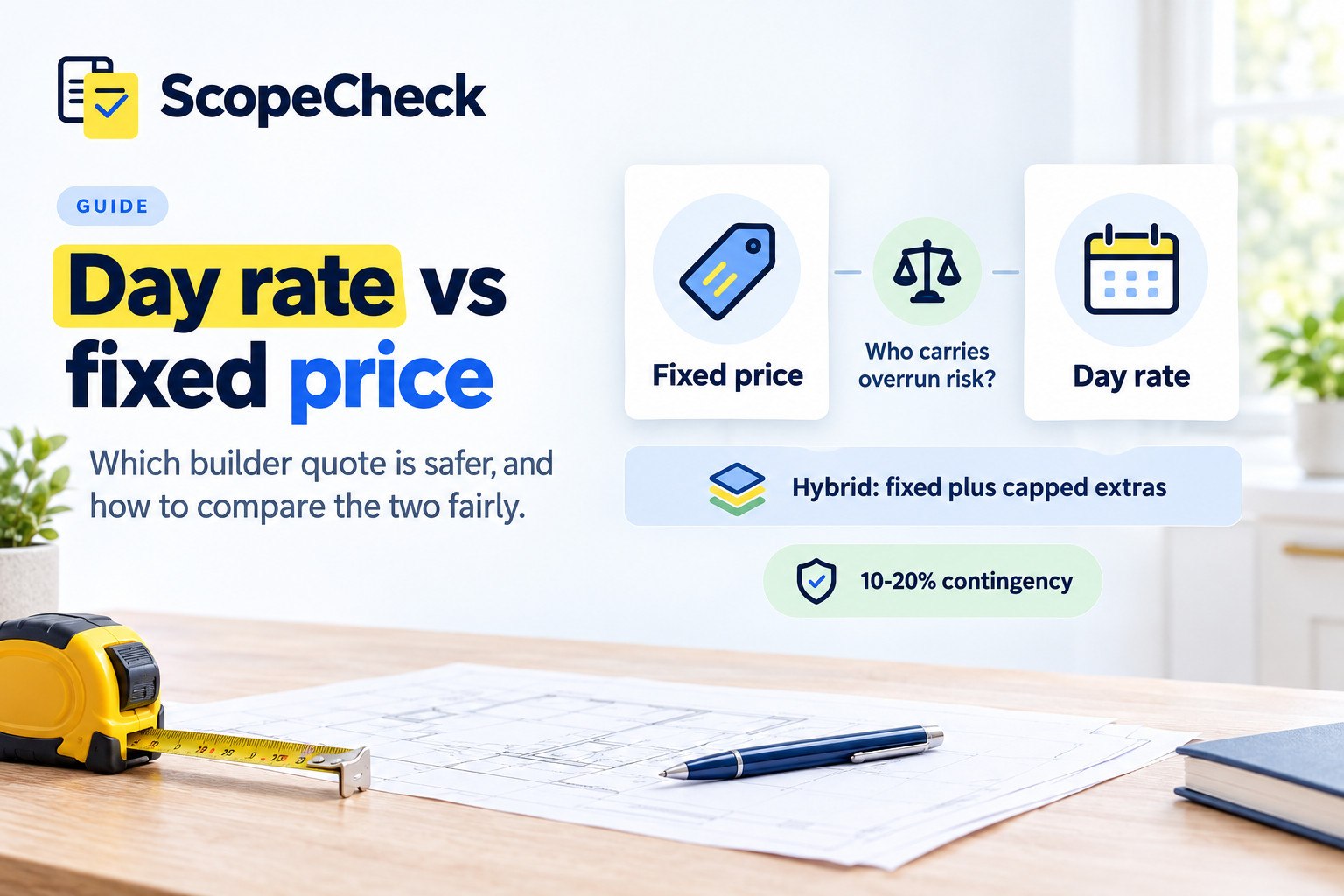
Builder day rate vs fixed price comes down to who carries the risk of the job taking longer or costing more. A fixed price is usually safer for a clearly defined job, because the builder has priced the risk and you know the total. A day rate can be reasonable for small, investigative or unknown-scope work, but you carry the overrun risk unless the quote sets a cap or a "stop and ask" point.
If you have one quote priced per day and another as a lump sum, they cannot be compared directly. This guide shows how to read each type, turn a day rate into a best-case and worst-case total, and see how a capped hybrid works. It is a general guide, not legal or financial advice.
Builder day rate vs fixed price at a glance
A fixed price suits work where the drawings, specification and access are clear. The builder estimates the risk and puts an allowance in the price. A day rate suits work where nobody can know the scope until it is opened up. A hybrid, with a fixed price for the defined work and an agreed day rate for genuine unknowns, is common and often sensible.
| Fixed price | Day rate | Capped day rate or hybrid | |
|---|---|---|---|
| Who carries overrun risk | Mostly the builder, for the stated scope | Mostly the homeowner | Shared, up to the agreed cap or approval point |
| How certain the total is | High, if the scope is clear | Low, unless an estimate and cap are written down | Fairly high for defined work, flexible for unknowns |
| What to check in the quote | Scope, exclusions, provisional sums, variations process | Hours in a day, people included, materials, estimated days, cap | Trigger for the day rate, the rate, who approves, how extras are recorded |
How each type of quote works
A fixed price is a lump sum for a stated scope of work. If the scope is described properly, the builder takes the risk of it taking longer than planned. Citizens Advice describes a quote as a trader's promise to do work at an agreed price, and says it should state what work will be done and the price. The page is about car repairs, but the definition of a quote is general. For repairs, it also says that if you agreed a price or got a quote beforehand, you generally have to pay the full bill, though you can ask for a reduction.
A day rate charges for labour by the day, per person or per team. Materials are usually billed separately, and the total depends on how many days the job takes. This is sometimes called time and materials. A time and materials builder quote in the UK should still say what the rate covers and how many days are expected.
Cost-plus means the builder charges actual costs plus a fee or percentage. It is the most open-ended of the three, because the homeowner sees the real costs but carries the risk of them rising.
Some quotes are really estimates, which are a best guess rather than a promise. If the document you hold is not clear on this, read the difference between a quote and an estimate before comparing anything.
When a fixed price is the better fit
A fixed price works best when the job is well defined. A bathroom refit, a roof strip and re-cover, or a kitchen installation are typical examples. If the layout, products, access and finishes are written down, the builder can price the work with reasonable confidence.
The builder's risk allowance is built into the price. That is the trade-off: you may pay a little more than the best case of a day-rate job, but you are not exposed to the worst case. For a typical fixed price extension quote, that certainty is often the main reason to prefer it. A fixed price quote vs day rate extension comparison often favours the fixed price because extensions involve many trades and long durations, where small delays add up.
Two cautions apply:
- A very low fixed price can mean gaps in scope. If one quote is far below the others, check what has been left out before celebrating. See what to look at if a builder quote is much cheaper than the others.
- A fixed price still needs a variations process. Changes you request, and genuinely unforeseen items, should be agreed in writing with a price before the work goes ahead. Without that, the "fixed" total can drift.
When a day rate makes sense (and what to get in writing)
A day rate can be a fair fit where the scope genuinely cannot be fixed in advance:
- Investigative work, such as tracing a leak or opening up a wall to find out what is behind it.
- Small repairs, where writing a detailed specification would cost more than the job.
- Open-ended snagging or odd jobs around the house.
The risk of an open-ended day rate is simple: if the job overruns, you pay for every extra day. So a day-rate quote should not just say "£X per day". Ask for these points in writing:
- Length of a working day. Hours on site, and whether travel and breaks are included.
- Number of people included. Is the rate for one person or a team, and do labourers cost extra?
- Materials. Are they billed at cost with receipts, or marked up, and by how much?
- Estimated number of days. Even a rough range is better than none.
- A cap or "stop and ask" point. For example, the builder agrees to stop and confirm with you before the total passes an agreed figure.
- Records. How daywork records or timesheets will be shared, and how often.
If no price was agreed at all, the Consumer Rights Act 2015 implies that the price must be reasonable, that the trader uses reasonable care and skill, and that work is done within a reasonable time where no timescale is agreed. That is a safety net, not a plan. "Reasonable" can be argued about, and it is far easier to agree the terms first. This is general information, not legal advice. For your own situation, check with Citizens Advice or a qualified adviser.
So should you pay a builder a day rate? It is worth considering when the unknowns are real and the builder is willing to write down the terms above. It is harder to justify for a well-defined job where a fixed price is available.
How to compare a builder day rate vs fixed price quotes
The aim is to turn the day rate into a range of totals, then set that range beside the fixed prices. Here is a method, using illustrative numbers only, not market prices:
1. Take the day rate, the number of people and the estimated days. 2. Add materials, then skip and waste removal. 3. Make a best case (the job goes smoothly) and a worst case (it overruns). 4. Compare that range, not a single figure, with the fixed totals.
Example: a day rate of £200 per person, two people on site.
| Item | Best case | Worst case |
|---|---|---|
| Labour (2 people x £200 x days) | 8 days: £3,200 | 14 days: £5,600 |
| Materials at cost | £2,500 | £3,000 |
| Skip and waste | £300 | £400 |
| Total | £6,000 | £9,000 |
Now suppose two fixed-price quotes for the same job come in at £7,500 and £8,200 (again, example figures). Both sit inside the day-rate range. The day-rate quote might finish cheaper, or it might cost more than both. The fixed prices remove that uncertainty, so the question becomes whether the saving in the best case is worth the exposure in the worst.
Also set aside a contingency of your own. The Federation of Master Builders says a renovation budget should cover more than the builder's main quote and recommends a contingency fund of 10% to 20%. It adds that this matters most in older homes, where hidden issues such as damp, rotting timber or outdated wiring are more likely to appear once work begins. This applies to fixed-price jobs as well as day-rate ones.
Check that the fixed quotes are like for like. Provisional sums can make part of a fixed price behave like a day rate, because the final cost depends on what is actually needed. Read about provisional sums in builder quotes and ask how each one was calculated. For the wider method, see how to compare builder quotes line by line.
ScopeCheck lines up the wording of 2 to 5 quotes side by side, so differences such as a missing skip, a provisional sum or an unstated day length are visible rather than buried in different layouts.
The hybrid: fixed price plus a capped day rate for unknowns
Many jobs have a defined core and a few genuine unknowns. A hybrid handles both: a fixed price for the defined work, plus an agreed day rate, with a written cap or approval step, for things nobody can see yet. Typical unknowns are hidden defects behind existing finishes or groundworks that depend on what is found when the ground is opened.
A builder quote with a capped day rate should write down:
- The trigger. What counts as an unknown, for example "defects found once the old floor is lifted".
- The rate. The day rate for that extra work, and what it includes.
- Who approves. The builder stops and gets your written agreement before going further, or before the extras pass the cap.
- How the extra is recorded. A short note of days, people and materials, shared with you promptly.
This keeps the main price firm while giving the builder a fair way to deal with surprises. It also avoids the habit of padding a fixed price against every possible problem. If a final bill ends up higher than expected, what to do if a builder charges more than the quote explains how to check the paperwork first.
Questions to ask a builder who offers only a day rate
A day rate is not a red flag by itself. These questions help you judge it:
- Why can't this job be priced as a fixed sum, and could part of it be?
- What is your estimate of the duration, and what happens if it overruns?
- Can the day rate be capped, or can we agree a point where you stop and check with me?
- What is the day rate for variations or extra work?
- How will materials be invoiced, at cost with receipts or with a mark-up?
- How often will I see timesheets or daywork records?
A builder's willingness to answer in writing is useful information in itself. A clear, specific reply suggests they have thought about the job. A vague or reluctant one tells you something too. Separately, a quote that will not itemise at all is a different problem, and worth resolving before you commit.
Frequently asked questions
Is it cheaper to pay a builder a day rate or get a fixed price?
Neither is always cheaper. A day rate can come out lower if the job runs smoothly, but it can cost more if it overruns. A fixed price usually includes a risk allowance, in exchange for a known total.
Can a builder change a fixed price quote once the work has started?
A fixed price should only change if the scope changes, and that should be agreed in writing with a price first. If you are unsure of your position, check the written terms and seek advice from Citizens Advice.
What should a day-rate quote include?
It should state the length of a working day, how many people the rate covers, how materials are charged, an estimated number of days, and a cap or approval point. It should also say how records of time worked will be shared.
Do I pay for materials on top of a builder's day rate?
Usually yes, unless the quote says otherwise. Ask whether materials are charged at cost with receipts or with a mark-up, and whether skip hire and waste removal are included.
What if a builder starts work without agreeing a price?
The Consumer Rights Act 2015 implies that the price must be reasonable where none was agreed. It is much better to agree the price and terms in writing before work begins. For a specific dispute, speak to Citizens Advice or a legal professional.
Next step: compare the quotes you have
If you hold one day-rate quote and one or more fixed prices, the useful question is what each one actually includes. You can compare your quotes with ScopeCheck, with 2 to 5 quotes side by side, and see what is included, what is missing and where the prices really differ. ScopeCheck compares quotation wording only. It does not inspect work or give legal or financial advice.